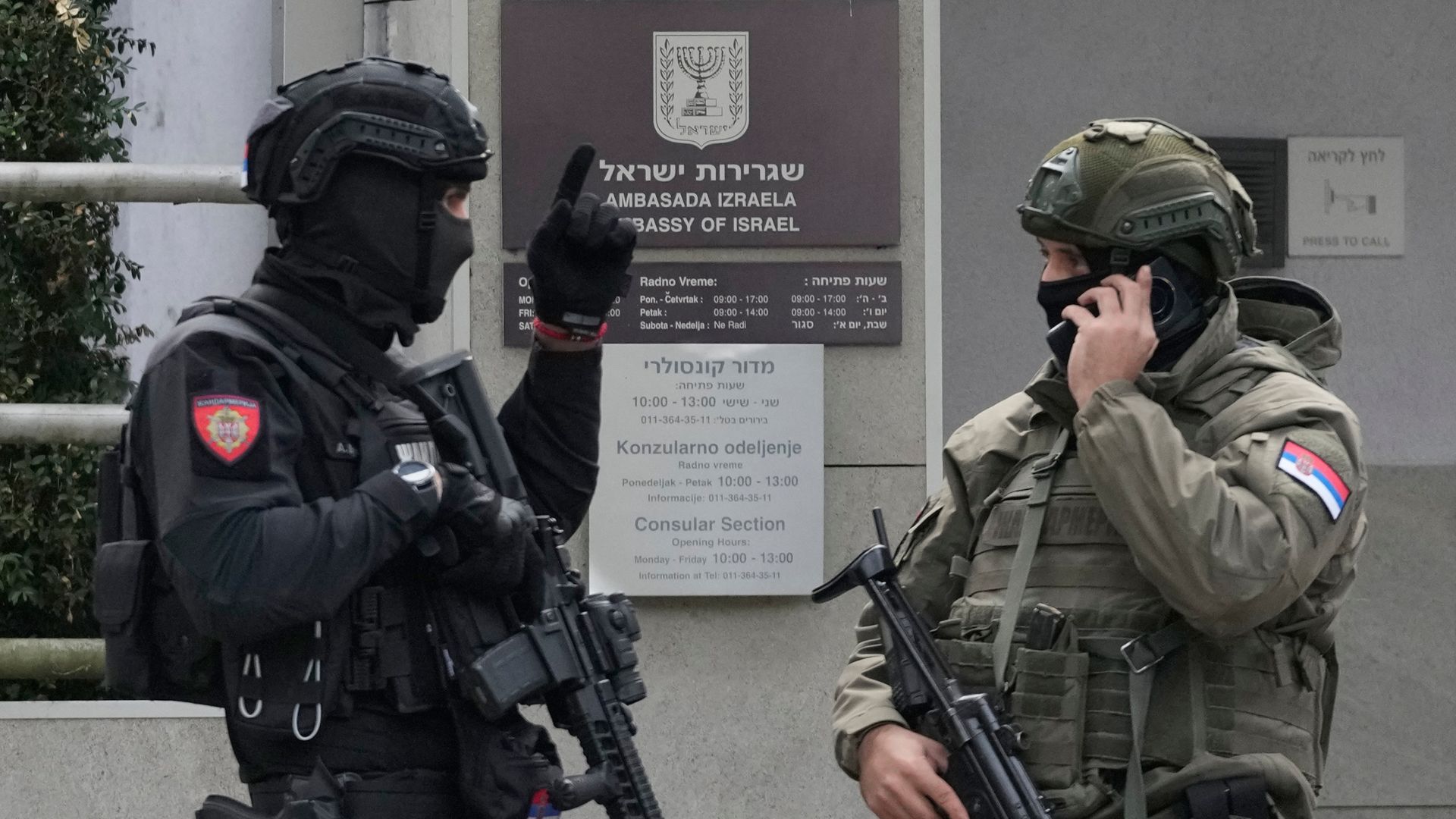
When armed officers fatally shoot a knife-wielding assailant outside an Israeli embassy, the immediate public narrative settles into a familiar, predictable rhythm of breaking news alerts, cordon tape, and boilerplate statements from municipal police departments. Yet beneath the surface of any lethal confrontation at a diplomatic compound lies a complex, unforgiving machinery of diplomatic security architecture, split-second use-of-force doctrine, and the stark vulnerability of fixed urban targets. The shooting is rarely an isolated street crime; it is the final, violent collision between an asymmetric threat and a multi-layered defensive perimeter engineered specifically to stop an attacker before they cross a threshold.
Most wire reports treat these incidents as self-contained dramatic events, focusing entirely on the number of shots fired, the immediate medical response, and the temporary closure of surrounding city blocks. That framing misses the structural reality. An Israeli diplomatic mission—whether in Washington, London, Paris, Berlin, or an emerging capital—operates under a threat matrix fundamentally distinct from almost any other foreign legation on earth. Understanding why a lone individual with an edged weapon triggers an immediate, lethal response requires examining the intersection of international diplomatic law, modern ballistic realities, and the operational scars left by decades of targeted attacks against diplomatic personnel.
The Invisible Architecture of Diplomatic Perimeters
To the casual pedestrian walking past a consular building, security appears to be a collection of visible obstacles—concrete planters, steel bollards, reinforced glass, and uniformed guards standing near a heavy gate. In practice, these physical features represent only the outermost skin of a concentric defense model. Under the 1961 Vienna Convention on Diplomatic Relations, specifically Article 22, the host nation bears an absolute, non-negotiable legal duty to take all appropriate steps to protect the premises of a diplomatic mission against any intrusion or damage, and to prevent any disturbance of the peace of the mission or impairment of its dignity.
This legal mandate creates a divided operational reality on the sidewalk. Everything outside the physical property line falls under the primary jurisdiction of local law enforcement—specialized diplomatic protection units, armed response teams, or federal protective services. Everything inside the gate belongs to the sending state's own security apparatus, which for Israeli missions typically involves personnel trained by the Shin Bet (Israel Security Agency) operating under strict internal protocols.
When a suspect approaches the perimeter carrying a knife, the spatial geometry of the street becomes the decisive factor. Urban embassies are rarely situated on sprawling, isolated campuses with hundred-yard setbacks. They are wedged into dense commercial districts, diplomatic rows, or residential neighborhoods where public sidewalks run within feet of the building facade. There is no buffer zone. A pedestrian can transition from an unremarkable passerby to an active assailant in less than two seconds.
The Physics of the Edged Weapon Threat
A persistent public misconception surrounding police shootings involving knives is the belief that an attacker holding a blade poses a fundamentally lesser threat than an attacker holding a firearm, and should therefore be subdued without lethal force. In law enforcement tactics and close-quarters combat doctrine, that assumption is flatly contradicted by human biomechanics.
Decades of empirical testing—most famously codified in the Tueller Drill, developed by Salt Lake City police sergeant Dennis Tueller in 1983—established a sobering baseline for reaction time versus closing speed. An average adult male can cover twenty-one feet in approximately 1.5 seconds. Within that same window, a trained officer must visually register the weapon, process the threat, clear a holster, acquire a sight picture, and press the trigger.
The math is brutal. If an assailant with a knife is within twenty feet of a stationary guard and begins a sprint, the guard is already behind the reaction curve before their hand even reaches their sidearm.
Edged weapons also present unique tactical complications compared to firearms:
- No Mechanical Malfunctions: A knife does not jam, run out of ammunition, or suffer from a failure to feed. As long as the attacker remains conscious and mobile, the weapon remains entirely lethal.
- Concealment Until Contact: Unlike a rifle or even a handgun, a fixed-blade knife can be concealed inside a sleeve, waistband, or coat pocket until the exact instant the attacker is within arm's reach of an officer's neck or torso.
- Immediate Incapacitation Failure: Even when an officer fires center-mass, handgun rounds rarely cause instantaneous physical collapse unless they strike the central nervous system. An attacker fueled by adrenaline or ideological fervor can absorb multiple rounds and still cover several yards to deliver a fatal stab wound.
Because diplomatic protection officers are explicitly tasked with holding a fixed post—they cannot simply retreat down the block and abandon the embassy entrance—their tactical options narrow dramatically. Retreating leaves the mission gate exposed to secondary attackers or a coordinated breach. Holding the line forces an immediate confrontation at dangerously close range.
Why Lone Actors Choose Edged Weapons Against Hardened Targets
When intelligence analysts examine attacks on diplomatic facilities, they look closely at the weapon selection. Historically, high-profile assaults on Israeli embassies involved sophisticated operational planning—the 1992 bombing of the Israeli embassy in Buenos Aires, for instance, utilized a pickup truck packed with explosives, killing twenty-nine people and demolishing the building. The 1994 London embassy bombing relied on a vehicle-borne improvised explosive device designed to penetrate perimeter defenses.
Over the past three decades, counterterrorism engineering has made those large-scale attacks vastly harder to execute. Blast-resistant architecture, hydraulic bollards capable of stopping a fifteen-ton truck at fifty miles per hour, and pervasive closed-circuit surveillance have effectively closed the door on complex vehicular assaults in major capitals. Intelligence agencies also monitor the acquisition of firearms, explosives precursors, and encrypted communications with relentless intensity.
The knife is the tactical answer to a hardened surveillance state.
Every kitchen drawer holds a weapon that requires no background check, no black-market connection, no financial transaction, and no digital footprint. For an individual operating outside a formal terror network—often radicalized online or driven by acute personal crisis—a blade eliminates every logistical hurdle between intent and execution. Security services refer to this as low-signature, zero-lead-time violence. Because there is no conspiracy to infiltrate and no bomb-making material to trace, the first indicator of the plot is often the blade being drawn on the sidewalk outside the embassy gate.
The Diversionary Threat Model
Diplomatic security personnel are trained never to view a lone attacker in isolation. One of the oldest doctrines in embassy defense is the decoy and breach scenario. In this tactical model, a single individual initiates a chaotic, loud, or visually dramatic confrontation at the main gate—waving a knife, shouting, or charging a uniformed guard—specifically to draw every available officer out of their protected positions and focus their attention on a single point of failure.
While the perimeter team converges on the knife-wielding suspect, a second operative or a vehicle approaches from a blind spot to breach the unguarded entrance or detonate a secondary device.
This doctrine explains why the police response outside an embassy looks overwhelmingly disproportionate to a casual observer. Within seconds of the first shot being fired, additional tactical units flood the perimeter, locks engage automatically, and officers maintain weapons-drawn postures long after the initial suspect is down on the pavement. They are not merely securing a crime scene; they are bracing for the second wave of a coordinated assault that may or may not materialize.
The Gray Area of Less-Lethal Force and De-Escalation
Whenever a suspect is killed by police outside a high-security facility, a predictable debate erupts regarding the failure to use less-lethal alternatives—conducted energy devices like Tasers, pepper spray, batons, or kinetic impact projectiles. Critics frequently ask why highly trained diplomatic units could not incapacitate a single person with a knife without taking a life.
The answer lies in the operational reliability of those tools under extreme stress.
A Taser, for example, relies on two small metal probes penetrating clothing and lodging in the skin at a sufficient spread to induce neuromuscular incapacitation. Heavy winter coats, loose jackets, or rapid lateral movement routinely cause one or both probes to miss or fail to complete the circuit. In real-world field deployments across major metropolitan police departments, single-cycle Taser effectiveness hovers around fifty to sixty percent.
In a standard domestic disturbance call, a fifty percent failure rate is an acceptable risk when multiple officers are present with lethal cover. Outside an Israeli embassy, where the baseline threat assessment assumes the attacker may also be wearing an explosive vest concealed beneath that same heavy jacket, a fifty percent chance of failure is treated as an unacceptable operational gamble.
The Suicide-by-Cop Factor
Investigators probing embassy perimeter shootings frequently encounter a disturbing psychological overlap between political violence and self-destruction. Security analysts have documented numerous instances globally where individuals with no ties to organized militant groups deliberately target heavily guarded diplomatic compounds precisely because they know the guards are armed, vigilant, and authorized to use deadly force.
In these scenarios, the embassy is chosen not because the attacker expects to breach the building, but because the attacker expects the perimeter to execute them. The political symbolism of the target provides a veneer of ideological meaning to what is fundamentally a suicidal act. For the officers on the pavement, however, intent is indistinguishable from capability. A person charging a guard with a ten-inch blade to end their own life inflicts the exact same physical trauma as a trained operative executing a political assassination.
The Post-Incident Investigative Machinery
The moment the shooting stops, an entirely separate, rarely seen bureaucratic collision begins. A fatal police shooting outside a foreign embassy triggers parallel investigations that often operate under competing legal mandates and diplomatic sensitivities.
First comes the host-nation criminal and internal affairs investigation. In jurisdictions with independent police oversight bodies—such as the Independent Office for Police Conduct in the United Kingdom or specialized district attorney units in the United States—every round fired by a local officer is forensically accounted for. Investigators pull body-worn camera footage, municipal CCTV feeds, and audio recordings of radio transmissions to establish the exact timeline of verbal warnings, distances, and perceived threat levels.
Simultaneously, the embassy's own security apparatus conducts an internal after-action review. Because diplomatic premises are inviolable under international law, local homicide detectives cannot simply walk inside the embassy compound to inspect cameras mounted on the interior facade or interview diplomatic staff without formal diplomatic consent. Information sharing between host-nation police and foreign intelligence officers happens through tightly controlled liaison channels, often filtered through the host country's foreign ministry.
The Intelligence Autopsy
While local detectives focus on whether the shooting was legally justified under domestic use-of-force statutes, intelligence analysts conduct an entirely different examination. They are looking for network signatures:
- Digital Forensics: Investigators immediately seize the deceased suspect's mobile devices to reconstruct their search history, encrypted messaging apps, and location data in the seventy-two hours preceding the attack. Did they scout the embassy perimeter days earlier? Did they photograph the guard rotation schedules?
- Financial Trails: Even a zero-cost knife attack leaves subtle behavioral markers—sudden cash withdrawals, travel tickets into the capital city, or the liquidation of personal assets.
- Contagion Monitoring: Security agencies across Europe, North America, and the Middle East instantly share the tactical details of the incident with their counterparts guarding other Israeli and Jewish institutions. High-profile attacks frequently trigger copycat attempts within days, forcing an immediate temporary elevation of alert levels at consulates, cultural centers, and synagogues worldwide.
The Permanent Cost of Urban Vigilance
There is no clean engineering fix for the vulnerability of an urban diplomatic post. Pushing perimeters further out into public streets alienates local neighborhoods, paralyzes municipal traffic, and turns embassies into fortress islands that undermine the very diplomatic engagement they exist to foster. Pulling security back inside the walls leaves officers blind to approaching threats until the glass is already shattering.
Every diplomatic mission operates inside that permanent, unresolved tension. For the officers standing six-hour shifts on cold concrete sidewalks outside an embassy gate, the job consists of thousands of hours of monotonous observation punctuated by three seconds of irreversible violence. When an individual steps off the curb with a knife in hand, the outcome is dictated long before the first shot echoes down the street—written into the physics of reaction time, the strictures of international law, and the uncompromising geometry of a perimeter that cannot afford to be breached.