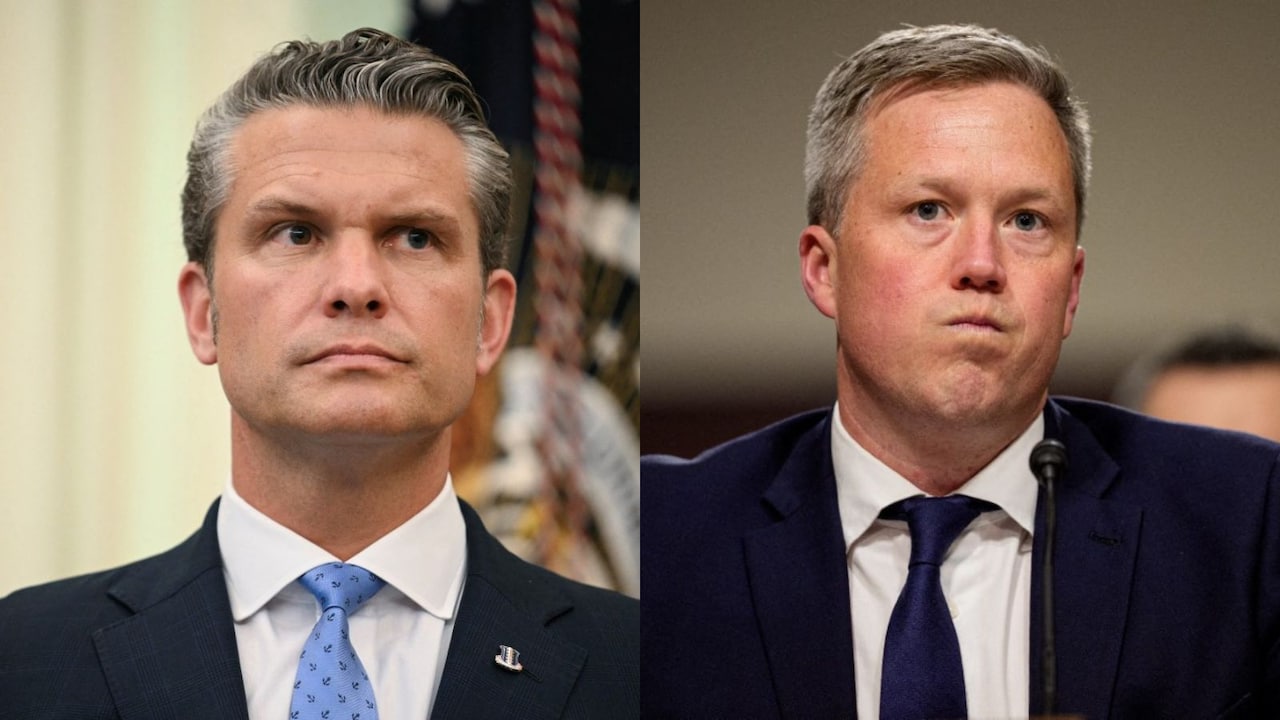
The institutional stability of the United States Department of Defense relies on a precise division of labor between civilian leadership and military execution. When structural friction develops between the Office of the Secretary of Defense and individual service branches, the resulting organizational vacuum affects everything from procurement cycles to operational readiness. Reports indicating that Army Secretary Dan Driscoll plans to step down by the end of 2026 illuminate the deep systemic strains currently reshaping the upper echelons of the Pentagon under Defense Secretary Pete Hegseth. Deconstructing this transition requires analyzing the power dynamics, the erosion of Senate-confirmed oversight, and the strategic cost of institutional churn during an active overseas conflict.
The Mechanics of Executive Friction
At the core of the reported tension between Defense Secretary Hegseth and Army Secretary Driscoll lies a misalignment of administrative vision and operational philosophy. Hegseth has pursued an aggressive consolidation of authority, marked by the abrupt removal of high-profile military and civilian leaders. In April, the ouster of Army Chief of Staff General Randy George—a close collaborator of Driscoll—removed a critical node in the Army’s command network without a public rationale.
When a defense secretary systematically replaces service branch leadership with loyalists or acting officials, it alters the feedback loops necessary for effective defense policy. Driscoll's tenure was characterized by a heavy emphasis on rapid battlefield modernization, drawing operational lessons from Ukraine regarding unmanned systems and electronic warfare. The friction point emerged not merely from policy disagreements, but from competing centers of gravity within national security decision-making. Driscoll’s alignment with vice-presidential circles and his positioning as a potential successor introduced political dynamics that complicated the standard chain of command.
The Cost Function of Leadership Vacuums
The departure of a Senate-confirmed service secretary creates quantifiable institutional costs. Without permanent leadership, long-term acquisition programs suffer from strategic drift. The United States Army currently faces a dual vacancy risk: the potential exit of Driscoll leaves the civilian post open, while the military side continues to operate under acting leadership following General George's departure.
This creates three distinct operational bottlenecks:
- Procurement Stagnation: Contractors and private capital commitments—such as the twenty-five billion dollars in infrastructure and technology pledges negotiated during Driscoll's tenure—face implementation delays when executive champions depart.
- Congressional Oversight Friction: Legislative bodies rely on Senate-confirmed officials to provide transparent testimony regarding force readiness. Acting officials lack the institutional standing to push back against sweeping budget or personnel directives from the Office of the Secretary of Defense.
- Strategic Continuity: With U.S. forces engaged in active regional conflicts, institutional memory at the secretariat level is critical for coordinating logistics and force rotations. Frequent turnover degrades the institutional learning curve.
The Broader Consolidation Pattern
The tension surrounding the Army secretariat is not an isolated administrative dispute, but part of a wider pattern of centralized control across all military branches. Similar friction points have manifested in the Department of the Navy, where leadership chafed against being sidelined on shipbuilding and structural allocation decisions. By systematically removing service secretaries and senior generals, the Office of the Secretary of Defense is centralizing power away from the traditional branch-specific fiefdoms.
While centralized command can accelerate decision-making in theory, within a bureaucracy as massive as the Pentagon, it often produces compliance-driven paralysis. Lower-level commanders hesitate to surface operational risks upward when they observe structural purges of leadership for non-compliance or unstated reasons.
Strategic Assessment
The anticipated exit of Army Secretary Dan Driscoll marks a definitive shift toward a more centralized, executive-heavy defense apparatus under Secretary Hegseth. To mitigate the risk of severe institutional degradation, the administration must expedite Senate confirmations for permanent civilian and military leadership to restore institutional checks and balances. The strategic imperative for the Pentagon is to balance centralized political alignment with the technical expertise required to manage global force readiness. Without stable, confirmed leadership in the military departments, strategic execution will remain vulnerable to internal political friction.