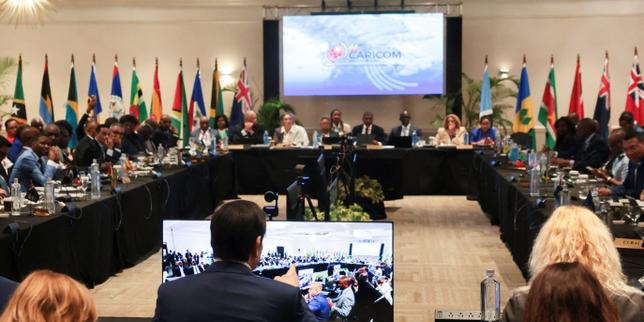
The accession of French Guiana (Collectivité Territoriale de Guyane) to the Caribbean Community (CARICOM) as an associate member exposes the structural tension between European sovereignty and regional integration. While political commentary frames the admission at the 51st Heads of Government Meeting in Saint Lucia as a milestone for regional unity, a cold economic analysis reveals severe functional boundaries. French Guiana operates under a dual-layer institutional framework that limits its agency. All regional commitments executed by the local government are legally bound by French constitutional law and European Union (EU) treaties, rendering full integration mathematically impossible under current regulatory structures.
To understand the trajectory of this membership, one must deconstruct the structural boundaries, the divergent geopolitical incentives, and the legislative bottlenecks governing French Guiana’s regional economic policy.
The Three Pillars of Structural Friction
The integration of an EU Outermost Region into a sovereign Caribbean trade bloc creates structural frictions across three distinct operational pillars.
1. The Tariff and Trade Boundary
French Guiana is bound by the EU Common Commercial Policy and the Union Customs Code. It cannot independently negotiate tariffs, enter into bilateral trade agreements, or waive import duties for CARICOM member states. The territory relies on the octroi de mer (dock dues), a centuries-old tax levied on imported goods—including those from mainland France and the Caribbean—to fund local municipalities.
- The Conflict: CARICOM aims to eliminate intra-regional trade barriers through the CARICOM Single Market and Economy (CSME).
- The Reality: French Guiana cannot participate in the market integration aspects of the Treaty of Chaguaramas without violating EU competition laws. Trade will remain governed by the EU-CARIFORUM Economic Partnership Agreement, not CARICOM inner mechanisms.
2. The Monetary and Currency Bottleneck
Operating within the Eurozone establishes a high-value currency regime relative to most CARICOM nations, with the exception of those pegged directly to the US dollar. This creates a persistent trade deficit vulnerability for French Guiana. Local production costs—driven by French labor laws, minimum wage standards (SMIC), and mandatory European environmental regulations—are significantly higher than the regional average. Consequently, cross-border commerce will likely result in asymmetrical import surges from lower-cost Caribbean producers, while French Guiana's exports remain non-competitive in terms of pricing.
3. The Competence Deficit
Under Article 73 of the French Constitution, French Guiana holds limited decentralized authority. While the territory can negotiate regional cooperation agreements, it lacks foreign policy competence. The French Republic retains exclusive jurisdiction over international relations, defense, and macro-border security. Every agreement signed by the President of the Territorial Collectivity requires explicit authorization or subsequent ratification from Paris.
The Institutional Compromise of Associate Membership
Because full membership requires state sovereignty, CARICOM developed the associate member status as a functional workaround for non-independent territories. This status contains clear structural boundaries that separate symbolic alignment from execution power.
| Functional Dimension | Full Member Capability | Associate Member Limitation (French Guiana) |
|---|---|---|
| Voting Rights | Full voting power on binding decisions. | No voting rights in the Conference of Heads of Government. |
| Foreign Policy | Foreign policy coordination (COFCOR). | Strictly prohibited. French Ministry of Foreign Affairs retains monopoly. |
| Market Access | Participation in CSME and free movement of labor. | Excluded. Bound by Schengen area principles and EU labor codes. |
| Agency Access | Direct access to all functional specialized agencies. | Case-by-case participation in technical committees (e.g., climate, health). |
This structural matrix clarifies that French Guiana's accession is not an economic merger, but an institutional bridge designed to facilitate technical cooperation while insulating both the EU and CARICOM from legal friction.
Divergent Geopolitical Incentives
The driving forces behind this accession are asymmetric, with Paris, Cayenne, and Georgetown pursuing distinct strategic imperatives.
[Geopolitical Incentives Matrix]
├── France (Paris): Soft power projection + EU-Caribbean geopolitical counterweight
├── French Guiana (Cayenne): Supply chain diversification + Reduction of import dependence on Paris
└── CARICOM (Georgetown): Institutional footprint expansion + Diplomatic leverage via EU outermost regions
The French state views this integration as a vehicle for soft power projection. By embedding French Guiana—alongside Martinique's 2026 accession—into Caribbean governance structures, Paris establishes a direct channel of influence within a region increasingly courted by alternative global powers. Furthermore, it allows France to utilize its Caribbean territories as a geopolitical counterweight, aligning regional policies with broad European strategic goals.
For the local administration in Cayenne, the primary driver is the mitigation of geographic isolation. French Guiana imports a vast majority of its consumer goods directly from mainland France, situated over 7,000 kilometers away. This creates highly inefficient supply chains and inflates the local cost of living. Accession provides a formal framework to negotiate direct regional procurement channels for energy, agriculture, and construction materials, bypassing long-distance European shipping routes.
CARICOM's incentive structure centers on institutional expansion and resource pooling. Integrating French territories expands the bloc's geographic and economic footprint. While French Guiana does not participate in the single market, its inclusion grants CARICOM specialized agencies access to French technical expertise, European development funds via the Interreg Caribbean program, and enhanced regional coordination on shared challenges like climate adaptation, maritime security, and public health management.
Operational Bottlenecks and Practical Realities
The primary operational challenge of this accession is the reconciliation of two fundamentally incompatible legal frameworks. CARICOM operates on a model of intergovernmental consensus among sovereign states without a formal transfer of supranational authority. Conversely, French Guiana is subordinate to the supranational legal architecture of the European Union.
This creates an immediate bottleneck in phytosanitary and regulatory standards. A local producer in French Guiana cannot easily import agricultural goods from neighboring CARICOM states because those goods must comply with strict EU European Food Safety Authority (EFSA) mandates. Therefore, the establishing of regional supply chains will be dictated not by CARICOM agreements, but by the speed at which Caribbean exporters can meet rigorous European import criteria.
Furthermore, free movement of people—a core tenet of CARICOM's long-term vision—remains entirely off the table. French Guiana is subject to French immigration laws and border controls. The territory faces significant irregular migration pressures across its long river borders with Suriname and Brazil. Paris will maintain tight immigration oversight, ensuring that associate membership does not translate into simplified entry requirements for regional nationals.
The Strategic Play
To extract measurable value from this associate membership without violating its constitutional restrictions, French Guiana must focus its regional strategy away from broad trade integration and toward targeted technical and structural plays.
- Execute Spectrum and Infrastructure Alignment: Utilize the recent admission to the Caribbean Telecommunications Union (CTU) to synchronize cross-border spectrum coordination with neighboring Suriname and Guyana, reducing interference and building redundant digital infrastructure.
- Leverage Dual-Funding Mechanisms: Position the territory as an intermediary for joint European-Caribbean environmental initiatives, combining EU Green Deal capital with CARICOM Climate Change Centre (CCCCC) regional execution frameworks.
- Establish Functional Technical Protocols: Direct regional cooperation exclusively through non-binding specialized agencies—such as the Caribbean Disaster Emergency Management Agency (CDEMA)—where functional collaboration does not require the transfer of sovereign legislative powers.
Success will be measured by the territory's ability to lower its local supply chain costs through targeted regional procurement exemptions permitted under EU outermost region status, rather than the unrealistic expectation of full integration into the Caribbean economic space.