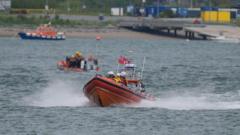
Commercial maritime operations in high-latitude winter environments represent a complex equilibrium between structural stability, environmental forcing, and emergency response mechanics. When a 72-foot commercial fishing vessel like the Lily Jean founders, standard media reports focus on the narrative of a sudden tragedy. A rigorous analysis reveals that sinking incidents are rarely the result of a single isolated failure. Instead, they are driven by a predictable cascade of thermodynamic laws, hydrodynamic instabilities, and the severe physiological constraints of cold-water survival.
An examination of the structural and environmental physics governing maritime accidents demonstrates why the margin between routine operations and catastrophic failure is narrow, and how modern search and rescue (SAR) systems function under extreme constraints. Building on this idea, you can also read: The Anatomy of Strategic Realignment: A Brutal Breakdown of India’s Diplomatic Shift in Riyadh.
The Triad of Vessel Instability
A vessel stays upright because of the relationship between its center of gravity and its center of buoyancy. In winter commercial fishing, this equilibrium is constantly threatened by three distinct physical factors that compound exponentially when a ship faces severe weather.
       [ Top-Heavy Mass: Ice Buildup ]
                     |
                     v
   [ Shifts Center of Gravity Upward ]
                     |
                     v
[ Reduces Righting Arm (GZ) -> Free-Surface Effect ]
                     |
                     v
       [ Catastrophic Capsizing ]
1. Thermodynamic Mass Accumulation
When ambient air temperatures drop significantly below freezing—such as the 12°F (-11°C) conditions documented off Cape Ann—and winds exceed 20 knots, a phenomenon known as superstructure icing or "freezing spray" begins. Sea spray striking the cold metal surfaces of the vessel freezes instantly. Analysts at Al Jazeera have provided expertise on this matter.
This accumulation introduces an un-designed load concentrated entirely on the upper decks, rigging, and superstructure. The direct consequence is a rapid upward shift in the vessel’s vertical center of gravity. As the center of gravity rises, the distance between it and the metacenter decreases, directly degrading the vessel's metacentric height and its inherent ability to right itself after pitching or rolling.
2. Hydrodynamic Free-Surface Effects
Concurrently, if a vessel is returning to port to repair damaged gear, structural openings, compromised hatches, or blocked freeing ports (scuppers) can trap water on the deck. When water accumulates on a deck faster than it can drain, it creates a "free-surface effect."
As the ship rolls, this untrapped water shifts to the low side of the vessel. The moving weight actively counteracts the ship's natural righting energy, moving the center of gravity laterally and drastically accelerating the speed of a roll. Combined with the added weight of superstructure ice, the vessel reaches a point of no return where the righting arm becomes negative, causing an instantaneous capsize.
3. The Velocity of Mechanical Failure
The absence of a verbal voice distress call (Mayday) via Very High Frequency (VHF) radio indicates the speed at which the stability threshold was crossed. A rapid capsize traps air pockets within the hull but submerges the communication antennas immediately, preventing manual transmission.
Under these conditions, emergency notification relies entirely on automated, water-activated systems: an Emergency Position-Indicating Radio Beacon (EPIRB). Designed to float free from a bracket when submerged under hydrostatic pressure, the EPIRB broadcasts a 406 MHz distress signal directly to geostationary and low-Earth-orbiting satellites, providing search coordinators with initial geographic coordinates.
The Mathematics of Search and Rescue Under Thermal Stress
Once an EPIRB activates, the SAR mission transitions from a tracking exercise to a race against tight physiological clocks. The operational execution of a search pattern is governed by mathematical models designed to account for environmental drift and human survivability limits.
The Survival Equation in Frigid Waters
The primary limiting factor in northern winter maritime rescues is not the speed of the aircraft, but the thermal conductivity of water. Water conducts heat away from the human body approximately 25 times faster than air of the same temperature.
In water temperatures near 39°F (4°C), an unprotected human experiences a predictable physiological timeline:
- Cold Shock Response (0–3 minutes): Immediate loss of breathing control, hyperventilation, and increased heart rate, raising the risk of immediate drowning if the face is not kept clear of the water.
- Functional Criticality (10 minutes): Rapid cooling of peripheral muscles and nerves, leading to a loss of manual dexterity and the inability to hold onto flotation devices, regardless of mental resolve.
- Hypothermia-Induced Unconsciousness (1–2 hours): Core body temperature drops below critical levels, leading to a loss of consciousness.
Even if individuals successfully deploy an inflatable life raft, ambient air temperatures of 12°F paired with 24-knot winds produce a severe wind-chill factor that accelerates hypothermia unless survivors are equipped with insulated immersion suits.
Calculating Search Areas Amid Drifting Debris
To locate survivors or wreckage, search coordinators apply environmental data to calculate a Probability of Detection (POD). This calculation is structured around two variables:
$$Total \ Drift = Leeway + Total \ Water \ Current$$
Leeway represents the movement of an object through the water caused by the wind pushing against its exposed surfaces. A fully deployed, weighted life raft has a low leeway factor, whereas an empty, unanchored life raft or loose deck debris will drift rapidly downwind.
When a nor'easter or severe weather front approaches, wind vectors and sea currents shift continuously. The 1,000 square miles searched by Coast Guard assets off Massachusetts represent the geometric expansion of the initial datum point over a 24-hour period, reflecting the compounding uncertainty of where ocean currents and high winds have moved objects of varying densities.
Technical Investigations and Structural Archaeology
When an incident results in total loss with no survivors, structural archaeology and data collection replace eyewitness testimony. The joint investigation launched by agencies like the U.S. Coast Guard and the National Transportation Safety Board (NTSB) shifts from emergency response to forensic engineering.
Deep-Sea Imaging and Anomaly Mapping
Because the physical evidence lies in deep waters—often exceeding 300 feet—the investigation relies on high-resolution side-scan sonar systems towed behind specialized vessels. Side-scan sonar transmits acoustic pulses across the seabed, measuring the amplitude of the reflections to map the topography and identify structural anomalies that match the dimensions of the vessel's hull.
Once an anomaly is located, investigators deploy Remotely Operated Vehicles (ROVs) equipped with multi-beam sonar and high-definition optical cameras. The objective is to examine specific areas of the hull to diagnose the root cause of the sinking:
- Hatch Integrity and Openings: Evaluating whether fish holds, lazarette hatches, or engine room doors were secured or structurally breached.
- Rudder and Propulsion Status: Determining if the vessel suffered a catastrophic mechanical failure that left it beam-to-the-sea (paralyzed perpendicular to the waves), maximizing its exposure to breaking waves.
- Rope and Gear Entanglement: Checking if the heavy commercial fishing nets or trawl doors snagged on the ocean floor or became tangled in the propeller, arresting the vessel's momentum and pulling it down by the stern.
Operational Limitations of Fleet Safety Frameworks
While commercial fishing is statistically classified among the highest-risk occupations globally, regulatory and operational frameworks can only mitigate, never eliminate, the hazards of high-latitude winter operations.
The inclusion of federal data collection personnel, such as National Oceanic and Atmospheric Administration (NOAA) fisheries observers, highlights the dual purpose of modern commercial voyages, which balance commercial extraction with regulatory compliance. However, even vessels equipped with modern safety gear remain vulnerable to the sheer speed of stability failure.
The ultimate limitation of maritime safety systems is that they are reactive. An EPIRB confirms a catastrophic event has already occurred; it cannot prevent it. Survival suits buy time, but only if the crew has the physical stability and time required to don them inside a rolling, icing vessel before entering the water.
Future safety protocols must focus on predictive stability monitoring—using onboard sensor arrays to calculate a vessel's real-time metacentric height during icing events—allowing captains to view live data showing when their ship's structural safety margin is approaching zero before a critical roll begins.
The operational reality of searching for a sunken fishing vessel highlights how crucial rapid rescue response is during cold-weather maritime emergencies. For a detailed breakdown of the real-world conditions and assets deployed during high-seas search and rescue operations, see this Coast Guard briefing on the Gloucester fishing boat sinking. This video provides context on how freezing sea spray and severe weather directly compromise ship stability and complicate rescue efforts.


