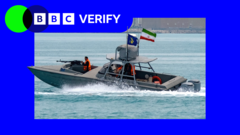
The institutionalization of asymmetric maritime leverage has fundamentally altered global energy logistics. On May 20, 2026, Tehran codified its informal blockade of the Strait of Hormuz by standing up a new regulatory entity: the Persian Gulf Strait Authority (PGSA). Operating under the direct mandate of the Supreme National Security Council and enforced by the Islamic Revolutionary Guard Corps Navy (IRGCN), the PGSA has declared a "controlled maritime zone" that unilaterally redraws the boundaries of operational risk in the Middle East.
By extending its claimed jurisdiction from the tip of Qeshm Island all the way south to the waters outside the United Arab Emirates’ port of Fujairah, Iran is no longer merely threatening to close a chokehold. It is executing a formal administrative and kinetic strategy to extract rents, dictate international shipping rights, and neutralize Western-backed infrastructure designed to bypass the strait.
Understanding this shift requires discarding superficial political rhetoric. An examination of the operational, legal, and economic mechanisms behind Iran’s actions reveals a highly calculated strategy to convert geographic positioning into permanent geopolitical capital.
The Three Pillars of the PGSA Operational Framework
Iran’s strategy relies on transitioning from reactive, kinetic interdictions to a continuous, bureaucratic control model. This administrative siege is built upon three distinct pillars:
Jurisdictional Expansion
The PGSA’s declared boundary maps an expansive polygon across the Gulf of Oman and the Strait of Hormuz. The western transit gate is defined by a line running from Qeshm Island to Umm Al-Quwain (UAE). The critical escalation lies in the eastern boundary, which stretches from Kuh-e Mubarak on the Iranian coast to a point directly south of Fujairah.
This geographic positioning is deliberate. Fujairah is the terminus of the Abu Dhabi Crude Oil Pipeline (ADCOP) and the newly fast-tracked West-East Pipeline, strategic infrastructure built specifically to bypass the Strait of Hormuz by moving crude directly to the Indian Ocean. By encompassing the waters south of Fujairah within its "controlled maritime zone," Tehran has structurally invalidated the bypass utility of these pipelines. Vessels loading at Fujairah must now choose between defying Iranian authorization protocols or accepting the PGSA's jurisdiction outside the Persian Gulf.
Sovereign Authorization Protocols
Under pre-war norms, transit through the Strait of Hormuz was governed by international law, allowing uninterrupted commercial passage. The PGSA framework completely replaces this with a closed-loop command structure.
All commercial vessels must now secure explicit, real-time coordination and authorization from Iranian authorities before entering the polygon. The IRGCN manages this through continuous VHF radio challenges broadcast from stations on Qeshm Island and coastal batteries. Military vessels belonging to states deemed adversarial by Tehran—specifically the United States and its allies—are completely prohibited from entry.
Rent-Extraction Architecture
The establishment of the PGSA introduces an economic mechanism designed to offset the impact of international sanctions: transit and protection fees. By framing these levies as necessary costs for safeguarding maritime infrastructure and underwater data cables, Iran is attempting to establish a self-funding maritime regime.
Refusal to comply carries immediate kinetic consequences. The March 11 attack on the Thai-flagged bulk carrier Mayuree Naree, which was struck by IRGC projectiles after departing the UAE, serves as the operational baseline for non-compliance.
The Cost Function of Chokepoint Monopolization
The closure and subsequent administrative constriction of the strait since late February 2026 has exposed the structural vulnerability of global supply chains. The economic damage is not a linear consequence of volume reductions; it is an exponential function driven by risk pricing and systemic bottlenecks.
The baseline capacity of the Strait of Hormuz prior to the current conflict averaged roughly 20 million barrels per day (bpd) of crude oil and petroleum products, alongside over 20 percent of global liquefied natural gas (LNG) shipments. The sudden restriction of this corridor created an immediate structural deficit in the global energy market. While Iran has selectively permitted limited numbers of vessels to pass—such as a convoy of approximately 30 ships, including Chinese-operated hulls under specific "Iranian-managed transit protocols"—the aggregate transit volume remains drastically depressed.
This restriction introduces two primary macroeconomic disruptions:
The Insurance Risk Premium Escalation
The cost of transiting the region is governed by the war risk insurance premium, calculated as a percentage of the total hull value of a vessel. Following the initial kinetic exchanges under Operation Epic Fury, underwriters raised these premiums by four to six times within a single week.
For a standard Very Large Crude Carrier (VLCC) valued at $100 million, a 1% war risk premium adds $1 million per voyage before factoring in standard freight rates, crew hazard pay, and bunker fuel costs. This steep increase operates as an invisible economic tariff on every barrel of oil loaded in the Gulf, driving global inflation and reducing the efficiency of maritime transport.
[Global Energy Chokepoint Linkage]
Persian Gulf Oil/LNG Production -> Strait of Hormuz Choke (PGSA Polygon) -> Risk Premium (4-6x Insurance Hike) -> Global Inflationary Shock
The Systemic Multiplier Effect
The disruption extends far beyond oil and gas markets. The Persian Gulf is a primary production hub for industrial inputs:
- Aluminum: Smelters in the UAE, Qatar, and Bahrain rely on free maritime access to export primary aluminum to global manufacturing supply chains.
- Fertilizers: The region exports massive volumes of urea and sulfur, critical inputs for global agricultural systems.
- Helium: Qatar accounts for approximately 35% of global helium production, an element vital for semiconductor manufacturing and medical imaging technology.
The restriction of these non-energy commodities creates a cascading bottleneck. United Nations trade data indicates that persistent instability in Hormuz is a primary driver behind the projected deceleration of global trade growth, with East Asian economic growth expected to slow from 5.0% in 2025 to 4.4% in 2026.
The Legal Fiction of the Controlled Maritime Zone
Tehran’s administrative framing of the PGSA is explicitly designed to mimic legitimate international maritime regulatory frameworks, yet it creates a direct conflict with established international law. The legal battleground centers on the distinction between two regimes established under the 1982 United Nations Convention on the Law of the Sea (UNCLOS):
Transit Passage vs. Internal Waters
The Strait of Hormuz is recognized as an international strait linking an exclusive economic zone (EEZ) to the high seas. Under Part III of UNCLOS, such straits are governed by the regime of transit passage, which guarantees all ships and aircraft freedom of navigation and overflight solely for the purpose of continuous and expeditious transit.
Crucially, coastal states cannot suspend, restrict, or condition transit passage upon prior authorization or the payment of arbitrary transit fees. By requiring prior coordination and threatening kinetic retaliation for non-compliance, Iran is attempting to unlawfully convert an international strait into internal waters or territorial seas subject to absolute sovereign veto.
The Belligerent Rights Paradox
Iran justifies its restrictions by pointing to the ongoing conflict with the United States and Israel, asserting wartime rights of self-defense. However, international maritime law, reinforced by historical precedents like the 1949 Corfu Channel case, establishes that even during active hostilities, belligerent states cannot lawfully block or attack neutral merchant shipping transiting international straits.
The enforcement of a total or selective blockade requires formal declaration, universal notification, and impartial application. By operating a discretionary transit system—favoring Chinese vessels while targeting or barring others—the PGSA operates outside the legal boundaries of recognized naval warfare, functioning instead as a system of state-sponsored maritime extortion.
Strategic Limitations and the Vulnerability Matrix
The PGSA architecture appears formidable, but it possesses structural vulnerabilities that limit Iran’s long-term capacity to sustain this strategy. No silver bullets exist for Tehran; the consolidation of control over Hormuz carries severe internal and external risks.
- Symmetrical Containment Vulnerability: The Iranian economy remains highly dependent on external trade for consumer goods, agricultural inputs, and industrialized components. While the IRGCN can deter Western shipping, the U.S. military maintains its own counter-blockade on Iranian ports. Tehran cannot completely seal the region without systematically strangling its own domestic economic survival.
- The Diplomatic Friction Point: By asserting authority over the waters south of Fujairah, Iran directly encroaches upon the sovereign maritime rights and economic exclusive zones of Oman and the UAE. This geographic overreach has already forced Abu Dhabi to fast-track its West-East Pipeline infrastructure. Over the long term, this high-handed unilateral enforcement alienates regional neighbors and incentivizes joint international naval counter-measures, threatening the very security guarantees Iran seeks to extract in ongoing peace talks.
- Rapid Multi-Domain Reconstruction Dependence: Western intelligence indicates that Iran is rapidly rebuilding its drone and missile production facilities, which were degraded during the initial phases of the war. The viability of the PGSA’s kinetic enforcement mechanism depends entirely on the speed of this production cycle. If industrial bottlenecks or intelligence operations disrupt the replenishment of anti-ship cruise missiles and uncrewed surface vessels, the PGSA will lack the teeth to back up its administrative threats against heavily escorted commercial convoys.
The Strategic Playbook
The institutionalization of the Persian Gulf Strait Authority requires global energy markets and defense planners to shift from crisis management to a long-term containment and adaptation strategy.
For commercial shipping operators, optimizing for this reality requires a bifurcated approach. Fleet architectures must be adapted to clear the PGSA’s administrative hurdle where necessary by leveraging diplomatic backchannels, particularly through non-aligned intermediaries like Islamabad or Beijing. Concurrently, energy logistics firms must structurally price in a permanent 15-20% inflation rate on shipping overhead through the Gulf, adjusting spot-market pricing to match the reality of a restricted corridor.
For international states seeking to restore maritime equilibrium, the optimal move is not a direct kinetic challenge to the PGSA polygon, which risks triggering further asymmetric escalation. Instead, the focus must shift toward a strategy of aggressive infrastructure insulation. This requires securing and scaling the alternative terrestrial corridors—such as maximizing the throughput of the UAE’s West-East Pipeline and Saudi Arabia’s East-West Pipeline to the Red Sea—while systematically denying Iran the diplomatic legitimacy it seeks for its new regulatory framework during active negotiation windows.