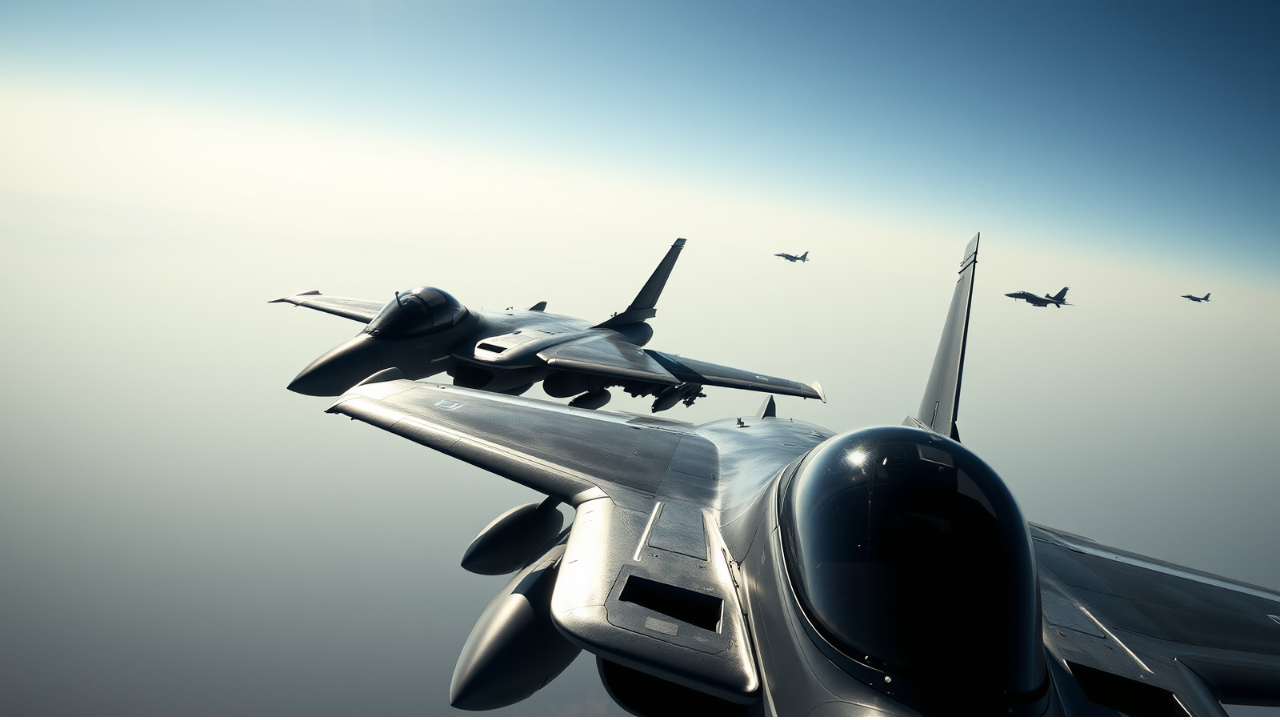
The sequential entry of more than 10 Chinese and Russian military aircraft into the Korea Air Defence Identification Zone (KADIZ) on June 27, 2026, highlights the operational friction defining Northeast Asian airspace. While standard media narratives frame these incidents as immediate precursors to conflict, a structural analysis reveals them as calculated, iterative probes designed to test detection latency, map radar gaps, and impose economic and readiness costs on the Republic of Korea (ROK) Air Force.
Understanding this dynamic requires separating sovereign territorial airspace from an Air Defence Identification Zone (ADIZ). Airspace extends 12 nautical miles from a nation's coast, governed by absolute sovereign jurisdiction under international law. An ADIZ is a self-declared unilateral buffer zone extending into international airspace. It carries no legal status under international treaties but serves an operational purpose: providing the host nation with the necessary early warning time to identify, track, and intercept approaching aircraft before they cross into sovereign territory.
The Operational Mechanics of the June 27 Intercept
The June 27 incursion over the East Sea (Sea of Japan) and the South Sea followed a precise behavioral pattern observed in previous joint exercises, such as the December 2025 incident involving nine aircraft. The Joint Chiefs of Staff (JCS) in Seoul confirmed that the formations, consisting of bombers and fighter jets, entered and exited the zone sequentially rather than as a single mass block.
This sequential entry pattern is designed to maximize the target nation's defensive friction through three distinct mechanisms:
- Radar Handover Testing: By routing aircraft across the intersection of the South Korean, Japanese (JADIZ), and Chinese (CADIZ) zones, Beijing and Moscow force regional militaries to execute rapid data handovers between distinct national command structures. This tests the communication latency between Seoul and Tokyo.
- Scramble Cycle Saturation: Massed entries force the ROK Air Force to deploy multiple waves of alert fighters. This disrupts standard training cycles and accelerates the airframe structural fatigue of South Korea's front-line fighter fleet, particularly its F-15K and KF-16 platforms.
- Electronic Intelligence Collection: As South Korean fighter jets scramble to intercept, accompanying Russian or Chinese electronic intelligence (ELINT) aircraft monitor the tracking frequencies, radar modes, and response times of the ROK Air Force’s ground-based radar arrays and airborne early warning platforms.
The Cost Function of Persistent Intercept Operations
For the defending nation, responding to unannounced ADIZ entries creates a clear asymmetry in resources. Under standard operating procedures, when an unidentified military aircraft approaches the KADIZ without a pre-filed flight plan, the ROK Air Force must launch its Quick Reaction Alert (QRA) assets. This creates a measurable cost function that favors the provocateur:
$$\text{Total Operation Cost} = C_{\text{fuel}} + C_{\text{depreciation}} + C_{\text{opportunity}}$$
Where $C_{\text{fuel}}$ represents the immediate fuel burn of twin-engine interceptors like the F-15K running at high speeds, $C_{\text{depreciation}}$ measures the irreversible consumption of finite airframe flight hours, and $C_{\text{opportunity}}$ accounts for the redirection of elite pilots away from advanced tactical training into routine, predictable intercept patterns.
China and Russia can offset these costs by utilizing joint strategic air patrols that they would run anyway for pilot training, effectively turning an internal training expense into an externalized strategic burden for South Korea. The lack of prior notification is an intentional tool used to deny South Korea the ability to monitor the flights passively via radar alone, forcing a physical scramble every time.
Structural Gaps in Regional Detection Capabilities
A primary strategic driver behind these joint patrols is the ongoing verification of regional radar capabilities. Beijing has previously claimed that its advanced platforms, including the J-20 stealth fighter, have operated inside regional identification zones undetected. Whether factually accurate or part of a broader psychological operations campaign, these assertions highlight a genuine technological vulnerability.
Ground-based and shipborne radar systems are bound by the physics of line-of-sight propagation and the curvature of the Earth. Low-observable (stealth) aircraft, combined with low-altitude routing over water, drastically shorten the detection horizon ($D$), which is structurally modeled by the standard radar horizon formula:
$$D \approx 3.57 \times (\sqrt{h_1} + \sqrt{h_2})$$
In this formula, $D$ is the distance in kilometers, $h_1$ represents the altitude of the radar antenna in meters, and $h_2$ is the target aircraft's altitude in meters. By lowering $h_2$ during approach or utilizing platforms with a reduced radar cross-section, advancing forces can delay detection until they are already deep within the KADIZ, reducing South Korea's response window from tens of minutes to single digits.
To mitigate this structural limitation, the ROK military relies heavily on airborne early warning and control (AEW&C) platforms, such as the E-737 Peace Eye. These aircraft position their radar antennas at high altitudes ($h_1$), eliminating the terrain shielding and sea-clutter limitations that degrade ground stations. However, maintaining continuous airborne coverage requires a massive fleet rotation, exposing a bottleneck in South Korea's current inventory of early warning airframes.
Geopolitical Alignment and the Pacific Defense Architecture
The alignment of Chinese and Russian air assets in these patrols reflects a deeper institutional coordination that has accelerated over the past several years. These flights are no longer independent reconfigurations of airspace; they are integrated, joint strategic operations designed to signal cohesion against the trilateral security architecture of the United States, South Korea, and Japan.
The geographic positioning of these incursions is telling. The operations frequently occur near the East China Sea and the Tsushima Strait—the precise maritime choke points that the U.S. Navy and its regional allies would need to secure in a Western Pacific contingency. By normalizing a heavy military presence in these sectors during peacetime, China and Russia are setting a baseline of high-tempo operations. This makes it difficult for regional analysts to differentiate between a routine provocative exercise and the actual deployment phase of an offensive operation.
The long-term response strategy for South Korea cannot rely solely on launching short-range interceptors to meet every unannounced airframe. Mitigating this gray-zone pressure requires shifting toward an asymmetric defense posture. This involves expanding automated, long-range radar networks, deploying unmanned maritime surveillance aircraft to track surface and low-altitude threats, and establishing direct, hardened communication hotlines between military command centers in Seoul, Beijing, and Tokyo to strip away the ambiguity that these flights exploit.