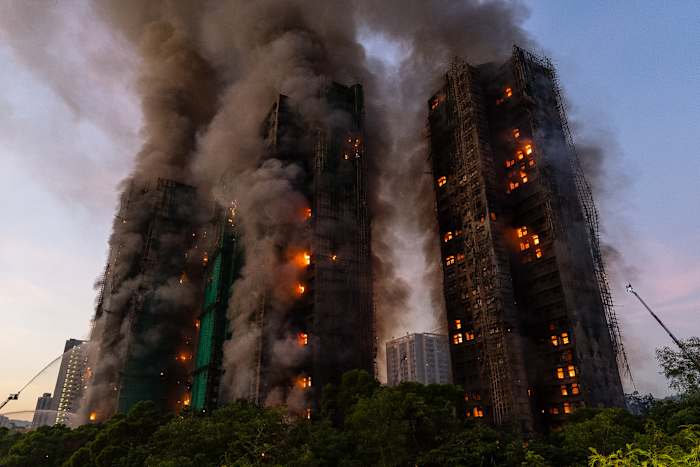
The fatal fire at the Wang Fuk Court residential complex in Tai Po, Hong Kong, which claimed 168 lives on November 26, 2025, was not an isolated operational accident. It represents a systemic intersection of corporate fraud, regulatory evasion, and structural engineering failure. When Hong Kong authorities handed down 25 criminal counts—including manslaughter, conspiracy to defraud, money laundering, and tax evasion—against seven individuals and two corporate entities, they exposed a critical vulnerability in urban infrastructure management: the decoupling of compliance from actual physical risk.
To evaluate how a routine HK$300 million (US$38 million) building renovation escalated into the city’s deadliest inferno in decades, analysts must look beyond immediate ignition sources. The disaster requires an examination through a strict structural-failure framework. The catastrophic outcome was dictated by a tri-part failure model: procurement fraud, material-driven fire acceleration, and systemic inspection omission.
The Procurement Fraud Matrix
The vulnerability of Wang Fuk Court was established long before the first spark, rooted in a corrupted tendering process that bypassed market-clearing safety mechanisms. The corporate entities charged—consultancy firm Will Power Architects Company and main contractor Prestige Construction & Engineering Co.—actively circumvented the risk-mitigation protocols built into Hong Kong’s procurement laws.
The conspiracy operated via data asymmetry. In a standard municipal or residential bidding process, a scoring matrix evaluates contractors based on historical litigation, financial stability, and past safety records. The prosecution alleges that Will Power and Prestige manipulated this matrix through two distinct mechanisms:
- Litigation Concealment: Prestige systematically withheld prior litigation records that would have structurally disqualified the firm or severely suppressed its safety rating during the tender analysis.
- Artificial Score Inflation: Will Power, acting as the independent project consultancy tasked with evaluating bids on behalf of the apartment owners, intentionally inflated Prestige’s metrics in the tender analysis report.
This collusion neutralized the economic safety premium. By presenting a corrupted data set to the property owners, the colluding parties secured a contract worth over HK$300 million. The immediate downstream effect was the elimination of independent oversight; the firm hired to protect the asset owners was financially and operationally aligned with the contractor maximizing profit margins.
Material Dynamics and Fire Acceleration
The physical mechanism of the disaster directly correlates with the cost-cutting measures enabled by this procurement fraud. Senior police superintendent Basil Tang confirmed that the rapid spread of the fire across seven apartment buildings was accelerated by the illicit use of non-fire-retardant materials.
In high-density residential architecture, scaffolding and exterior insulation act as a building’s envelope. When proper materials are deployed, this envelope limits fire propagation. In the case of Wang Fuk Court, the contractor deployed a highly combustible combination of non-fire-retardant scaffolding netting and foam boards.
The physics of the resulting vertical fire spread can be modeled by analyzing the fuel load and the stack effect. Standard fire-retardant netting is designed to self-extinguish or melt away without contributing to the thermal feedback loop. Non-retardant materials, conversely, introduce a massive, continuous hydrocarbon fuel load across the entire vertical plane of the structure.
This created a dual compounding hazard:
- Vertical Thermal Feedback: The burning foam boards and netting radiated intense heat back toward the building exterior, shattering residential windows and introducing the fire to multiple floors simultaneously. This bypassed internal compartmentalization walls.
- Egress Occlusion: As the scaffolding burned, flaming debris detached and collapsed into the primary egress pathways. The physical obstruction of escape routes, combined with dense toxic smoke from the synthetic foam boards, locked residents inside a rapidly accelerating thermal chamber.
Independent inquiry findings led by counsel Victor Dawes indicated that human error and systemic negligence caused almost all internal active fire safety systems—such as sprinklers and localized smoke curtains—to fail simultaneously on the day of the blaze. The internal suppression mechanisms were entirely overwhelmed by an external thermal load they were never designed to counter.
Systematic Oversight Omission and Regulatory Evasion
The most severe systemic breakdown occurred within the regulatory verification layer. In the civil engineering framework of Hong Kong, the Buildings Department relies on a network of Registered Inspectors to validate that construction practices match approved blueprints and safety codes.
The joint investigation by the Hong Kong Police and the Independent Commission Against Corruption (ICAC) exposed a massive, systemic evasion of this duty. The prosecution alleges that the defendants defrauded the government by falsely certifying that a registered inspector from Will Power had personally inspected and supervised operations. This fraudulent certification was not isolated to Wang Fuk Court; it extended across 86 separate building maintenance projects across the territory.
This reveals a deep operational bottleneck:
[Contractor Deviation from Safety Code]
                  │
                  ▼
[Consultancy Paperwork Fabrication] ────► [Zero Physical Inspection]
                  │
                  ▼
[Government Regulatory Acceptance] ────► [Systemic Vulnerability Hidden]
When an inspector signs off on works without executing physical verification, the regulatory framework shifts from a risk-reduction mechanism to a liability-shielding mechanism. Eighty-six assets were allowed to operate with unverified structural modifications, meaning the vulnerability identified at Wang Fuk Court is likely present elsewhere in the regional building stock.
Criminal Accountability and Strategic Risk Mitigation
The escalation of charges to manslaughter for Will Power directors Ng Yeuk and Wong Hap-yin, alongside Prestige director Ho Kin-yip, marks a significant shift in corporate liability enforcement. Historically, construction disasters were met with regulatory fines or corporate negligence penalties that could be absorbed as operational costs. Charging corporate officers with manslaughter ties the physical consequences of cutting costs directly to individual criminal liberty.
The inclusion of money laundering and tax evasion charges indicates that the financial infrastructure supporting these firms was designed to obfuscate illicit margins. When corruption drives procurement, financial irregularities inevitably follow. The capital saved by deploying subpar materials must be cleaned or hidden to prevent detection during standard corporate audits.
The structural limitations of current municipal safety strategies are clear. Relying purely on post-facto paperwork verification creates a market incentive for colluding firms to manufacture compliance on paper while maximizing margins in the physical environment.
To prevent similar failures in high-density urban environments, asset owners and municipal authorities must transition to a decentralized oversight model:
- Independent Third-Party Auditing: Project consultancies and main contractors must never be evaluated or chosen based on a single point of failure. A separate, unaligned third-party firm must conduct random, destructive testing of materials (such as lab-testing scaffolding netting samples for fire retardancy) directly from the active site.
- Immutable Field Verification: Regulatory bodies must mandate cryptographic, time-stamped, and geo-located logs of physical inspections. This makes it impossible for a single Registered Inspector to falsely claim concurrent verification across dozens of disparate projects.
- Transparent Tender Registries: Centralizing all corporate litigation, safety infractions, and past performance data onto an open, unalterable public registry eliminates the information asymmetry that Will Power and Prestige used to defraud apartment owners.
The Wang Fuk Court disaster demonstrates that when a regulatory system tolerates paper-only compliance and corrupt procurement, the laws of physics will inevitably expose the fraud. High-density urban centers cannot afford to treat building safety as an administrative exercise. Security is maintained only through rigorous, physical, and continuous verification of the engineering envelope.