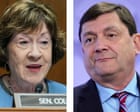
Incumbent politicians running in split-ticket jurisdictions face a structural optimization problem during nationalized midterm cycles: maximizing distance from an unpopular party leader among swing voters without triggering base defection. During the first October 2026 Maine U.S. Senate debate between five-term Republican Senator Susan Collins and Democratic challenger Troy Jackson, this strategic tension moved from background positioning to explicit verbal disavowal. According to reporting by The Guardian, CBS News, and Punchbowl News, Collins explicitly rejected the premise of political alignment with President Donald Trump, stating on stage that she was "not exactly his favorite senator" and dismissing the likelihood of a presidential campaign visit to Maine.
Standard political coverage treats a debate quip as a standalone news hook. A rigorous structural analysis reveals something far more consequential: the debate exposed the mechanics—and the terminal limits—of cross-partisan incumbent positioning when national executive policies directly collide with localized economic interests. Discover more on a connected issue: this related article.
The Structural Framework of Incumbent Differentiation
In multi-decade congressional careers, longevity in a state with a Democratic presidential lean depends on maintaining a distinct personal brand separate from the national party apparatus. When an incumbent's party controls the White House during a midterm election, the challenger's primary objective is nationalization—fusing the incumbent's identity to the executive branch. The incumbent's counter-strategy is localization and institutional independence.
During the October 6, 2026 debate moderated by Gregg Lagerquist, Collins deployed a three-part differentiation architecture to sever the link between her legislative record and the Trump administration: Further analysis by Associated Press highlights similar perspectives on this issue.
- Retrospective Bipartisan Indexing: Collins cited a quantitative metric from the prior administration, stating that she had voted with former Democratic President Joe Biden more than 90% of the time during his presidency. Rather than running on partisan loyalty, she framed her value proposition around cross-aisle legislative alignment.
- Executive War Powers Resistance: Addressing foreign policy, Collins highlighted her votes to restrict President Trump's authority to wage war against Iran. She characterized the conflict as "not well-thought out" and tied her opposition directly to domestic economic consequences, specifically noting its destabilizing impact on global energy markets.
- Geographically Targeted Trade Dissent: Collins positioned herself as "the most outspoken opponent of the tariffs on Canada," drawing a sharp distinction between geopolitical rivals and bordering trading partners by stating that Canada is "not China" but "our neighbor and our friends".
This framework was engineered to reinforce her long-standing brand as an independent institutionalist. However, every defensive maneuver in a high-stakes debate creates an opposing vulnerability that a disciplined challenger can exploit.
The Challenger Counter-Matrix
Democratic challenger Troy Jackson did not contest Collins's claim of rhetorical friction with the White House. Instead, as documented by CBS News and Punchbowl News, Jackson attempted to reframe her differentiation strategy as functionally ineffective. His counter-matrix rested on converting her institutional process into a liability across three distinct operational dimensions:
- Process Critique Versus Material Outcomes: When Collins cited her legislative pushback on tariffs and administration policies, Jackson mocked the approach as merely writing a "strongly worded letter". He anchored the critique in immediate household economics, arguing that symbolic dissent fails to alleviate cost-of-living pressures—summarized in his line that voters "can't eat road salt".
- Legislative Efficacy and Minority-Vote Framing: Jackson attacked the mechanics of Collins's voting record, arguing that casting occasional dissenting votes on measures guaranteed to fail "gums the system up" without altering policy outcomes. In doing so, he sought to neutralize her voting statistics by distinguishing between symbolic roll-call defections and decisive legislative blockades.
- Selective Accountability on Administration Priorities: While Collins emphasized her breaks with the president on Iran and Canadian trade, Jackson repeatedly tied her to broader administration initiatives, including the "One Big Beautiful Bill", as well as her prior votes against certain Iran-related measures and her past confirmation vote for Supreme Court Justice Brett Kavanaugh regarding Roe v. Wade.
The clash illustrated a fundamental asymmetry in electoral messaging. The incumbent argued from inputs—committee seniority, specific roll-call votes, and formal objections. The challenger argued from outputs—the persistence of tariffs, energy market volatility, and domestic inflation.
Why Tariff Policy Created an Acute Geographic Bottleneck
To understand why Canadian tariffs dominated the exchange, one must examine the economic geography of Maine. Unlike abstract ideological debates over judicial philosophy or foreign intervention, cross-border trade friction imposes immediate, measurable costs on a border state's supply chains.
Maine's economy relies heavily on integrated cross-border commerce with eastern Canadian provinces across forestry, paper manufacturing, agriculture, energy, and marine industries. When federal trade policy imposes broad tariffs on Canadian imports, the resulting retaliatory measures and input cost increases act as a direct tax on regional producers and consumers.
For Collins, this created an acute political bottleneck:
- Silence was untenable: Supporting or ignoring tariffs on Canada would alienate core rural and industrial constituencies in northern and central Maine whose livelihoods depend on cross-border trade.
- Opposition highlighted executive dominance: By loudly opposing the tariffs on stage, Collins validated Jackson's core thesis that the administration's trade war was actively harming every Mainer.
The subsequent trajectory of the race confirmed the severity of this pressure. Later in October 2026, President Trump exempted certain products from Canadian tariffs in a bid to bolster Collins's reelection effort. Yet by the November 2026 general election, Associated Press reporting noted that voter anger over the Canadian tariffs remained a decisive factor contributing to Collins's defeat by Jackson. Even a late executive policy adjustment could not undo the accumulated economic friction or erase the perception that the incumbent lacked the leverage to stop the policy at its inception.
The Asymmetric Risk of Executive Disavowal
A common misconception in political commentary is that publicly distancing oneself from an unpopular president carries zero downside for a moderate incumbent. In reality, explicit disavowal introduces a multi-variable risk function that alters voter turnout across different segments of the electorate.
When Collins reacted with visible discomfort to moderator Gregg Lagerquist's question about a potential Trump campaign visit—stating, "I don't think that President Trump is going to come to Maine" and noting she was "not exactly his favorite senator"—she was managing a delicate turnout equation:
- The Persuasion Gain (Independent and Soft-Democratic Voters): In a state where split-ticket voting is historically required for any Republican to win statewide, signaling distance from the White House reduces the penalty imposed by anti-administration independents.
- The Enthusiasm Penalty (Core Republican Base): Publicly rejecting a sitting president of one's own party risks depressing turnout among partisan loyalists who view the president as the primary driver of their political engagement.
- The Credibility Trap (Skeptical Swing Voters): When an incumbent simultaneously touts decades of party seniority while claiming estrangement from the party's leader, skeptical voters may view the positioning as tactical self-preservation rather than genuine ideological independence.
The broader 2026 Maine electoral map demonstrates how localized candidate dynamics interacted with national headwinds. While Jackson defeated Collins statewide in the Senate race amid a broader Democratic wave that flipped dozens of U.S. House seats, former Republican Governor Paul LePage narrowly won Maine's 2nd Congressional District—a rural, northern district covering logging, potato farming, and lobster fishing communities—following ranked-choice voting tabulation to succeed retiring Democratic Representative Jared Golden. The divergence between the statewide Senate outcome and the 2nd District House result underscores that voter backlash was not uniform across all Republican profiles, but rather concentrated where nationalized executive policies collided with expectations of legislative restraint.
Operational Limitations of the Incumbent Debate Playbook
Analyzing the October 2026 Maine Senate debate provides a clear set of operational boundaries for political strategists managing incumbents in hostile or swing environments. Relying on institutional polish and granular policy mastery—strengths Punchbowl News noted Collins displayed when capitalizing on Jackson's misstatements regarding a bipartisan housing bill and Medicaid versus Medicare—is insufficient when macroeconomic dissatisfaction dominates the electorate.
Three structural limitations define this approach:
- Granularity Loses to Macro-Framing: Correcting an opponent on legislative mechanics scores points with political observers, but it rarely shifts voters who are evaluating their household balance sheets. When affordability is the primary voting driver, technical debate wins do not offset macro-level economic grievances.
- Past Bipartisan Metrics Have Diminishing Returns: Citing voting alignment with a previous president anchors the campaign in the past rather than addressing current executive actions. Voters evaluate incumbents based on their present capacity to check or shape the sitting administration.
- Late Policy Concessions Signal Vulnerability: When an executive branch modifies a policy—such as partial tariff exemptions—weeks before an election to rescue an endangered incumbent, it implicitly confirms the challenger's argument that the policy was damaging and that relief arrived only due to electoral desperation.
Strategic Execution for Split-Ticket Incumbents
For campaign architects advising incumbents in cross-pressured jurisdictions, the Maine Senate debate offers a definitive operational mandate: rhetorical distance from an unpopular executive is a depreciating asset unless backed by tangible, early policy blocks.
To survive a nationalized wave election, an incumbent's strategy must execute three sequential shifts long before the autumn debate stage:
- Shift from Symbolic Dissent to Early Coalition Blocking: Waiting until a policy inflicts regional economic damage to voice opposition allows the challenger to define the incumbent as reactive. Incumbents must organize legislative blocks before executive actions take effect, converting potential policy failures into visible, preventative wins.
- Replace Defensive Explanations with Proactive Economic Alternatives: When challenged on unpopular administration initiatives, avoid litigating past confirmation votes or procedural technicalities. Pivot immediately to concrete, state-specific legislative remedies that directly address regional cost drivers.
- Control the Executive Relationship Early: Ambiguity regarding whether a president will campaign in a battleground state creates a recurring media distraction that forces the incumbent into defensive posture on live television. Campaigns must establish clear, unambiguous messaging around national surrogates months in advance so debate moderators cannot use surrogate speculation to fracture the incumbent's coalition.
Watch Sen. Susan Collins distances herself from Trump during Maine Senate debate for direct footage of the exchange in which Collins underscores her policy differences with the president on stage.