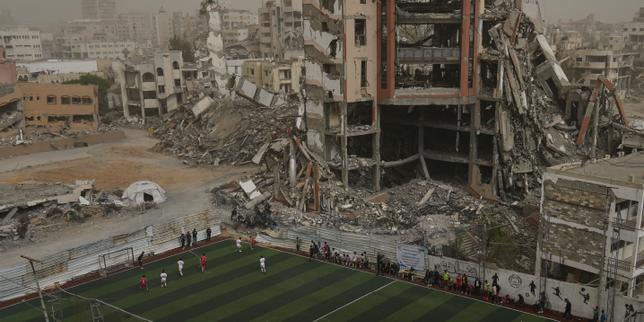
Public displays in municipal spaces operate under a strict equilibrium of civic tolerance, legal boundaries, and institutional risk aversion. When a local administration removes an exhibition from a public thoroughfare, the decision rarely stems from a sudden aesthetic disagreement. Instead, it exposes a systemic failure in risk governance and reveals how institutions calculate the threshold of public disruption. The recent removal of a photographic exhibition documenting events in Gaza from a public square in Deauville offers a textbook case study in administrative panic, jurisdictional ambiguity, and the mechanics of modern censorship.
To understand why municipalities fold under minimal pressure, one must examine the institutional cost function of public art. Local governments act as custodians of shared physical assets. Their primary optimization metric is the minimization of civic friction, not the maximization of discursive freedom. When a contentious exhibition enters the public realm, it introduces an immediate negative externality: the risk of property damage, unauthorized protests, or intense political polarization.
The institutional response follows a predictable vector. First, risk is identified by municipal stakeholders or external pressure groups. Second, liability concerns regarding public safety override freedom of expression protocols. Third, the administration executes a pre-emptive removal disguised as a measure of neutrality. This sequence ignores the structural purpose of public spaces as forums for democratic friction. By removing the photographs, the Deauville municipality did not neutralize the controversy; it relocated the debate from the domain of cultural critique to the domain of institutional accountability.
The mechanics of public space governance rely on three distinct operational layers. The first layer is the regulatory framework governing municipal authorisations. Exhibition spaces managed by local councils operate under permits that grant officials sweeping discretion to alter or revoke display rights under broad clauses concerning public order. These clauses are intentionally elastic. They allow authorities to act swiftly when a display threatens to exceed the acceptable bounds of local consensus.
The second layer is the economic and reputational incentive structure of resort towns. Municipalities like Deauville rely heavily on tourism, real estate stability, and high-net-worth visitors. Controversies that generate national headlines or social media polarization threaten the perceived tranquility of the urban brand. The removal of the exhibition functioned as a reputational hedge. Local leaders calculated that the cost of defending artistic freedom outweighed the cost of alienating specific interest groups or provoking public disorder.
The third layer involves the asymmetry of pressure applied to municipal offices. Advocacy groups and opposing political factions understand that local administrations are uniquely vulnerable to rapid escalation. A coordinated influx of emails, phone calls, and legal threats creates an artificial sense of crisis that overwhelms the standard bureaucratic review process. Officials confronted with this pressure rarely consult long-term free expression policies. They optimize for short-term hazard reduction.
The controversy also illuminates a broader systemic miscalculation regarding the nature of digital-physical spillover. Modern geopolitical conflicts do not remain geographically contained. They project themselves into local municipalities through digital networks long before a physical exhibition is installed. When photographs from conflict zones are placed in public squares, they act as physical nodes in a pre-existing digital war of narratives.
Municipal authorities routinely fail to account for this dynamic. They treat local art installations as benign cultural events rather than high-stakes ideological battlegrounds. Consequently, when local actors mobilize against an exhibition, the administration finds itself underequipped to manage the collision between international politics and local administrative law. The removal of the work is an admission of this operational failure. It demonstrates that the municipality lacked a coherent crisis communication strategy, an objective threat assessment matrix, and a firm commitment to institutional neutrality.
Evaluating the legality and ethics of such removals requires moving past surface-level political outrage and examining the structural decay of public discourse. When public space is sanitized to prevent discomfort, the municipality transforms from an open civic arena into a curated corporate zone. This shift carries severe long-term consequences for democratic health.
When citizens realize that public displays can be erased through targeted pressure campaigns, the incentive to lobby for censorship increases. Opposing factions learn that administrative disruption yields immediate results. This creates a race to the bottom where every future exhibition becomes a potential target for pre-emptive cancellation. The Deauville precedent signals to interest groups that municipal resolve is elastic, thereby inviting further challenges to cultural programming.
To reverse this degradation, administrative bodies must decouple public art authorization from short-term political weather. Independent curatorial boards should possess the legal insulation necessary to resist immediate public pressure. Furthermore, clear statutory definitions of public order must replace vague clauses that currently allow for arbitrary censorship under the guise of maintaining peace.
Establish explicit criteria for exhibition removal based strictly on verifiable threats to physical safety rather than ideological discomfort. Codify the independence of municipal cultural committees to ensure decisions withstand transient political pressure. Require absolute transparency in the decision-making chain when public art contracts are altered or terminated. Implement a mandatory review period that prevents hasty executive action during manufactured crises.