Capital asset remediation within public-sector infrastructure invariably exposes the friction between political expediency and structural engineering. The June 2026 completion of the Lincoln Memorial Reflecting Pool renovation serves as a pristine case study in how compressed timelines, parallel procurement mechanisms, and superficial system diagnoses combine to inflate asset lifecycles while failing to mitigate core technical failure modes. What was initially messaged as a rapid, $1.5 million cosmetic resurfacing evolved into a $14.2 million capital expenditure. Days after completion, the recurrence of biological fouling—specifically localized algal blooms—demonstrates that sealing a structural fluid vessel without addressing its underlying thermodynamic and hydraulic closed-loop vulnerabilities guarantees operational failure.
Understanding this outcome requires dismantling the project into three distinct operational vectors: the engineering mechanics of the fluid basin, the microeconomics of the no-bid procurement process, and the biochemical realities of stagnant water systems.
The Engineering Mechanics of Fluid Containment
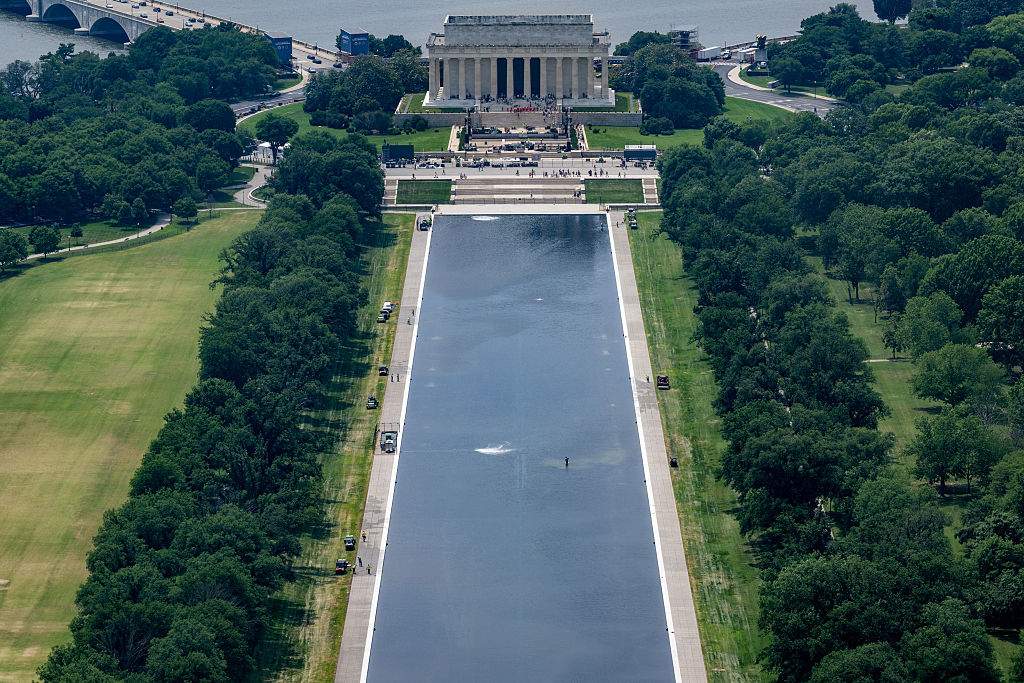
The Lincoln Memorial Reflecting Pool is an expansive, shallow concrete vessel spanning roughly two thousand feet in length and holding approximately 6.75 million gallons of water. It sits atop soft, marshy river clay along the Potomac River basin. Structural movement is an environmental constant. The primary engineering failure mode of the asset is structural fluid loss via compromised expansion joints and concrete porosity.
Public messaging positioned the 2026 intervention as a straightforward application of an industrial-grade polyurea swimming pool topping—tinted "American flag blue"—engineered to waterproof the basin.
This chemical barrier operates on a specific logic:
$$
\text{Fluid Retainment} = f(\text{Tensile Strength}, \text{Elongation Capacity}, \text{Substrate Adhesion})
防
$$
A high-elastomer polyurea membrane can bridge micro-cracks and accommodate the thermal expansion and contraction of concrete slabs. However, this intervention targets the symptom rather than the systemic cause of water depletion. The asset features thousands of linear feet of subterranean supply and drainage piping installed during prior overhauls, notably the $34 million remediation completed in 2012.
The structural bottleneck is located within these sub-surface distribution lines. Decades of shifting substrate layers have caused shearing and joint separation along the buried pipe network. When an impermeable barrier is applied strictly to the exposed concrete floor of the basin, the internal hydrostatic pressure within the supply lines remains unaddressed. Because the 2026 project scope explicitly excluded the comprehensive replacement of the subterranean plumbing network, the structural fluid loop remains compromised. Water continues to migrate out of the distribution system before it ever enters the basin, generating a hidden deficit that requires continuous municipal water input to maintain the necessary reflective surface elevation.
The Microeconomics of Compressed Procurement Timelines
The escalation of the project budget from a projected $1.5 million to an actualized $14.2 million offers a clear view into the cost functions of expedited public procurement. When a civil engineering project operates under an absolute, politically dictated deadline—in this instance, completion ahead of national mid-summer celebrations—the traditional triple constraints of project management (scope, cost, and time) are disrupted.
          [FIXED TIME]
     (Strict July Deadline)
             /   \
            /     \
           /       \
[VARIABLE SCOPE]--[INFLATED COST]
(Polyurea + Granite) (20% Profit Margin)
To achieve extreme schedule compression, the Department of the Interior utilized a sole-source, no-bid contract structure, bypassing standard federal competitive bidding protocols. This mechanism shifts the balance of economic leverage directly to the contractor, Atlantic Industrial Coatings. A subsequent National Park Service analysis revealed that the contract structure permitted a 20 percent overhead and profit margin—roughly double the standard 6 to 12 percent baseline typical for federal civil works.
The cost function of this compressed timeline is driven by three measurable inputs:
- Labor Premium Multipliers: Shifting construction schedules to a 24-hour, continuous-shift rotation introduces mandatory overtime premiums, overnight shift differentials, and increased labor density on-site, compounding the base labor cost per square foot.
- Material Expediting Fees: Procuring specialized chemical sealants and industrial application equipment outside of standard supply-chain lead times requires premium freight logistics and priority manufacturing allocations.
- Scope Creep Integration: Mid-stream changes to the project definition—such as the late addition of a $1 million allocation to repair and finish the perimeter granite stonework—were negotiated inside the non-competitive framework, preventing market forces from normalizing the cost of the additional labor and materials.
The contracting officer justified these inflated percentages by citing the extreme execution risk borne by the contractor due to the compressed schedule. In public procurement, speed functions as an expensive commodity; when time is fixed, cost becomes the primary shock absorber for any unforeseen operational friction.
Biochemical Stagnation and Hydraulic System Failures
The immediate visibility of organic matter and algae along the margins of the newly filled blue basin highlights a fundamental misunderstanding of hydraulic biochemistry. Algal proliferation in open-air aquatic systems is governed by a direct relationship between nutrient availability, solar radiation, and kinetic fluid energy.
$$
\text{Algal Growth Rate} \propto \frac{\text{Solar Radiation} \times \text{Nutrient Concentration (N, P)}}{\text{Fluid Velocity} \times \text{Dissolved Oxygen Levels}}
$$
When a large, shallow body of water is subjected to intense summer sunlight, it functions as a solar collector, rapidly elevating fluid temperatures. If the water remains stagnant, dissolved oxygen levels plunge, creating an optimal environment for rapid biological fouling.
The official explanation from the Department of the Interior attributed the early June biological growth to residual organic matter flushed from supply lines that had remained dormant during the eight-week construction window. While mechanically accurate—dormant lines accumulate bacterial biofilms and concentrated phosphates—the explanation obscures a deeper operational vulnerability.
To counteract this, the current management strategy relies heavily on the introduction of nanobubbler filtration systems designed to inject microscopic oxygen bubbles into the water column. The objective is to elevate dissolved oxygen levels to suppress anaerobic conditions and disrupt algal cellular structures.
The limitation of this strategy lies in the structural bypass required during maintenance cycles. Because the primary subterranean plumbing network remains plagued by joint leaks, isolating and repairing any future pipe failure requires shutting down the entire circulation loop for weeks at a time. During these isolation windows, the nanobubbler systems lose their distribution mechanism across the 2,000-foot basin. The fluid shifts from a dynamic, aerated state to a static state. Without continuous kinetic movement and uniform oxygenation, the industrial polyurea coating—regardless of its visual hue—functions simply as the basin for an accelerated biological reactor.
Strategic Operational Forecast
The structural integrity of the Lincoln Memorial Reflecting Pool over the next decade depends entirely on transitioning from superficial surface remediation to systemic hydraulic overhaul. The current polyurea coating provides a short-term, high-cost moisture barrier that will inevitably face delamination pressures if sub-base shifting continues unmitigated.
The definitive strategic requirement for the site is the execution of the secondary infrastructure phase scheduled for late 2026. This phase must focus entirely on the wholesale replacement of the subterranean distribution trunklines. Managers must reject the narrative that surface coloration or localized filtration additions equal structural resolution. Until the underlying structural colander is replaced with a resilient, flexible HDPE (High-Density Polyethylene) piping network capable of withstanding substrate shifts along the Potomac basin, the asset will continue to demand high capital infusions to counter continuous water loss and cyclical biological fouling.