When United States aviation authorities issue a nationwide ground stop due to a communications failure, the action represents a deliberate, pre-programmed shift from dynamic air traffic optimization to deterministic risk elimination. Aviation infrastructure relies on continuous, low-latency data and voice synchronization to maintain spatial separation between aircraft moving at roughly 500 miles per hour. Once the integrity of that synchronization degrades below strict safety thresholds, regulators execute an immediate halt to departures—prioritizing the safe recovery of airborne inventory over commercial schedule adherence.
Standard media reporting typically frames these events as isolated technical glitches followed by chaotic airport delays. That framing misses the structural reality of the National Airspace System (NAS). A communications outage is not merely an inconvenience; it is a temporary collapse of the primary control loop governing modern flight operations. Understanding how these disruptions unfold requires mapping the technical architecture of aviation communications, the operational triage executed by Air Traffic Control (ATC), and the compounding mathematical physics of airline network recovery.
The Architecture of Aviation Communications
Modern air traffic management depends on redundant, multi-layered networks that transmit both voice directives and automated telemetry. When a broad communications issue triggers a ground stop, the failure rarely stems from a single broken radio. Instead, it indicates an interruption in the backbone infrastructure connecting regional control centers, airport towers, and airline dispatchers.
The Three Pillars of Airspace Control
To understand why a communications fault forces an immediate operational freeze, separate the control environment into three distinct functional layers:
- Air-to-Ground Voice and Data Links: Controllers communicate directly with flight decks using Very High Frequency (VHF) radio for tactical instructions and Controller-Pilot Data Link Communications (CPDLC) for routine clearances. Voice remains the ultimate fail-safe for immediate collision avoidance and vectoring in congested terminal airspace.
- Inter-Facility Ground Networks: En route centers (ARTCCs), terminal radar approach control facilities (TRACONs), and airport towers must constantly pass aircraft control authority from one sector to the next. This handoff process relies on dedicated terrestrial fiber networks and microwave relays, such as the Federal Aviation Administration's Telecommunications Infrastructure (FTI).
- Aeronautical Operational Control (AOC): Airlines operate parallel communications networks linking their centralized System Operations Control (SOC) centers to their fleets. Dispatchers use Aircraft Communications Addressing and Reporting System (ACARS) messages to transmit updated flight plans, fuel burn calculations, weight-and-balance manifests, and weather advisories.
A failure in the first two pillars degrades the FAA's ability to guarantee separation minimums. A failure in the third pillar prevents airlines from legally dispatching flights, as federal regulations require continuous, two-way operational control between an airline's dispatch center and the pilot in command throughout the duration of a flight.
Single Points of Failure in Legacy Infrastructure
Despite heavy redundancy, national airspace networks remain vulnerable to systemic choke points. Many foundational routing protocols and switching hubs operate on aging architectures undergoing multi-decade modernization cycles. Software update errors, corrupted routing tables, or localized physical severing of high-capacity fiber trunk lines can sever communication pathways across multiple geographic sectors simultaneously.
When redundant pathways fail to execute an automatic failover—or when the failover itself introduces unacceptable latency or data packet loss—controllers lose visibility into sector capacity. In high-density airspace, even a 30-second interruption in voice or radar data transmission destroys the spatial awareness required to manage converging flight paths safely.
The Mechanics of a Ground Stop
A ground stop is a specific traffic management initiative (TMI) implemented by the Air Traffic Control System Command Center (ATCSCC). Unlike a ground delay program, which meters departures by assigning calculated takeoff times to smooth out arrival rates, a ground stop halts all departures destined for affected airports or sectors indefinitely.
Triage Logic Airborne vs. Grounded Inventory
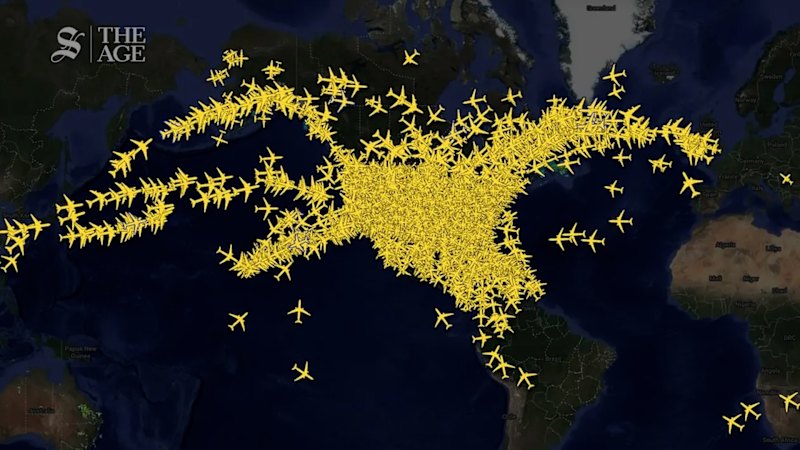
The moment a communications degradation is detected, air traffic management executes a strict operational triage governed by basic physics: aircraft already in the air cannot pull over.
- Airborne Aircraft: Controllers immediately prioritize existing airborne traffic. Without reliable automated handoffs or clear inter-facility voice lines, controllers must revert to manual coordination procedures, using backup frequencies or standard telephone lines to transfer aircraft between sectors. To keep this manual workload within human cognitive limits, controllers expand lateral and vertical separation buffers between planes, drastically reducing the maximum number of aircraft a single sector can safely hold.
- Ground Inventory: Every additional plane that takes off enters an already constrained airspace and adds to controller workload. By issuing a ground stop, the ATCSCC caps the total volume of airborne traffic. Aircraft sitting at the gate or on the taxiway remain in a zero-kinetic-energy state, completely insulated from mid-air collision risks while technicians isolate the fault and controllers clear the skies.
The Domino Effect on Ramp and Terminal Operations
While a ground stop solves the immediate airspace safety problem, it instantly creates severe physical congestion on the ground. Commercial airports are designed as continuous flow-through engines, not parking lots. Gate utilization schedules rely on tight turnaround windows—often 35 to 50 minutes for narrow-body domestic aircraft.
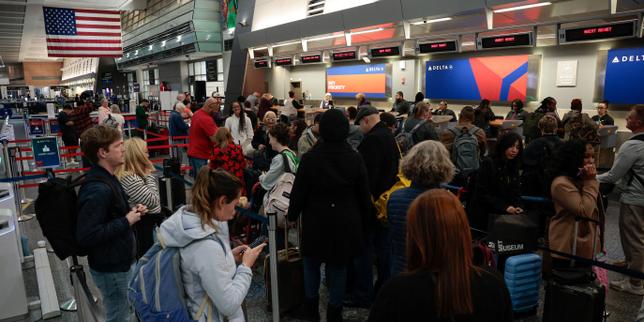
When departures stop, outgoing planes remain parked at their gates. Incoming flights—which continue to land as controllers clear the airborne backlog—arrive at the terminal with nowhere to park. Aircraft stack up on taxiways and designated penalty boxes. Once taxiways become gridlocked, newly landed planes cannot clear the active runways, eventually forcing the airport to halt arrivals entirely. This physical saturation transforms a communications issue into a hard infrastructure blockade within 60 to 90 minutes.
The Economics and Physics of Network Recovery
Restoring the communications link does not restore normal flight operations. The gap between technical resolution and schedule normalization is governed by queueing theory, federal labor laws, and network topology.
Why Delays Compound Non-Linearly
Airline schedules operate near maximum asset utilization. A single commercial airliner typically flies four to six legs per day, moving sequentially across multiple hub and spoke cities. This creates tight temporal coupling across the entire network.
When a two-hour ground stop interrupts the morning departure bank at major hubs, the resulting delay does not remain a static two-hour offset. Instead, it propagates downstream through a non-linear cascade:
- Missed Connections and Bank Desynchronization: Hub-and-spoke airlines schedule arrivals and departures in tightly choreographed waves (banks) to maximize passenger transfer efficiency. A communications halt breaks these banks. Airlines must choose between holding connecting flights—further compounding delays—or departing with empty seats, stranding passengers who must then be rebooked onto already full subsequent flights.
- Gate and Ground Crew Bottlenecks: Ramp workers, baggage handlers, and fueling trucks are scheduled around expected arrival banks. When delayed flights arrive simultaneously after a ground stop lifts, ground support equipment and personnel are overwhelmed, extending turnaround times from 45 minutes to over two hours.
- Runway Departure Queues: Once the ground stop is lifted, dozens of aircraft push back simultaneously. Runway departure capacity is fixed by wake turbulence separation rules—typically allowing one takeoff every 60 to 90 seconds per active runway. Clearing a backlog of 60 queued aircraft on a single departure runway requires at least an hour of uninterrupted operations, assuming zero weather interference.
Crew Legality and Timeout Cascades
The most rigid constraint in airline recovery is not mechanical; it is regulatory. Under Federal Aviation Administration rules (specifically FAR Part 117), flight crews operate under strict limits regarding maximum flight duty periods and mandatory minimum rest intervals.
These duty clocks start ticking the moment pilots report for work, regardless of whether the aircraft is flying or sitting at a gate during a communications outage. If a ground stop and the subsequent taxiway congestion consume three hours of a crew's scheduled duty day, the crew may legally "time out" before reaching their final destination—or even before taking off.
When a crew times out, the airline cannot simply extend their shift. The flight must be canceled unless a fresh reserve crew is physically present at that specific airport. Because communications outages often affect large regions simultaneously, airlines rapidly exhaust their local reserve crew pools, turning initial multi-hour delays into widespread cancellations that persist for 24 to 48 hours after the underlying technical fault is repaired.
Strategic Limits of Current Mitigations
Industry stakeholders frequently advocate for rapid infrastructure upgrades and decentralized routing to eliminate communications-driven ground stops. While modernizing legacy telecom architecture is necessary, relying purely on hardware redundancy has distinct operational limits.
The Complexity-Fragility Trade-off
Adding layers of automated failover systems and software-defined networking increases theoretical uptime, yet it simultaneously introduces higher systemic complexity. In tightly coupled digital networks, cascading software bugs or corrupted data states can propagate across redundant nodes faster than human operators can intervene. Backup systems designed to prevent localized hardware failures can inadvertently amplify network-wide synchronization errors if not strictly air-gapped.
Economic Constraints on Excess Capacity
From a commercial standpoint, airlines cannot insulate themselves against ground stops without destroying their unit economics. Maintaining enough spare aircraft, empty gates, and idle reserve crews at every major hub to absorb a sudden multi-hour nationwide halt would require carrying massive fixed overhead costs. In a low-margin, capital-intensive industry, pricing tickets to cover the cost of idle buffer capacity would render carriers uncompetitive during normal operating conditions.
Tactical Blueprint for Resilience
Because technical failures in complex national networks cannot be reduced to zero, aviation regulators, airline operations centers, and enterprise logistics managers must optimize for rapid, deterministic recovery rather than theoretical perfection.
- Enforce Hard Circuit Breakers in Network Architecture: Telecommunications providers and aviation authorities must segment regional control networks using strict logical isolation. Ensuring that a routing fault or software anomaly in one ARTCC cannot propagate telemetry corruption to adjacent centers contains the blast radius, limiting disruptions to regional ground stops rather than national freezes.
- Automate Dynamic Crew-Aircraft Re-pairing: Airline System Operations Control centers must deploy real-time optimization algorithms that decouple aircraft routing from crew pairings the moment a ground stop exceeds 45 minutes. Proactively reassigning unaffected crews to high-priority trunk routes prevents downstream cancellations caused by cascading Part 117 timeouts.
- Implement Pre-Staged Gate Buffer Protocols: Airport authorities and major hub carriers should maintain a dynamic reservation buffer of 5 to 8 percent of terminal gates during peak operating windows. Leaving a small fraction of gates unassigned provides an immediate pressure-relief valve to absorb inbound aircraft during sudden departure freezes, preventing runway lockup and preserving the physical mobility required to restart the network once communications clear.