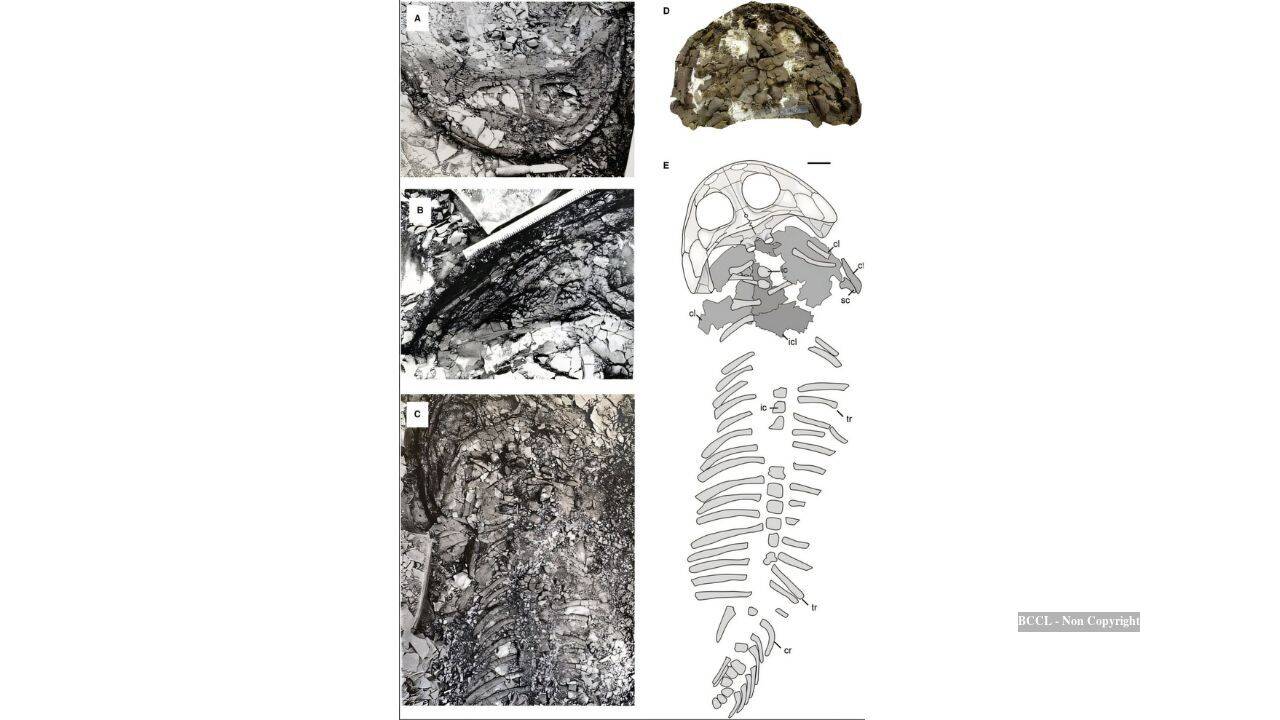
The formal classification of Arctobatrachus urdensis changes our baseline metrics for Triassic marine apex predators. Recovered from the high-latitude strata of Bjørnøya in Svalbard, Norway, this specimen resolves decades-old structural gaps in the plagiosaurid family tree.
Standard reporting frames this discovery through the lens of adventure: a fossil abandoned by a British expedition in 1948, weathered by Arctic sub-zero extremes, and miraculously rescued decades later. This narrative obscures the actual scientific vector. The real value of the find lies in its physical morphology, its role as a basal lineage anchor, and its demonstration of extreme gigantism following post-extinction thermal recovery periods.
Evaluating the mechanics of this specimen requires breaking down its taxonomy, functional morphology, and evolutionary constraints into distinct analytical components.
The Morphological Constraints of Basal Plagiosaurids
Plagiosaurids represent an extinct family of aquatic temnospondyl amphibians that thrived throughout the Triassic period, roughly 251 to 201 million years ago. Their defining anatomical feature is extreme body plan specialization characterized by flattened heads and bodies designed for benthic, or bottom-dwelling, ambushes.
Arctobatrachus urdensis pushes these parameters to an extreme. Measuring approximately 2.7 meters or 8.9 feet in total length, it stands as the largest plagiosaurid specimen on record.
The skull geometry dictates the functional mechanics of the animal:
- Proportional Skew: The skull spans roughly 70 centimeters wide against a longitudinal length of only 21 centimeters.
- The Boomerang Profile: This extreme width-to-length ratio creates a semi-circular, wide-arc outline.
- Hydrodynamic Suction: The massive internal mouth volume combined with marginal dentition indicates an ambush feeding strategy based on rapid pressure differentials, drawing prey directly into the oral cavity via suction.
Earlier evolutionary iterations of this lineage maintained more flexible, active swimming profiles with less exaggerated dorsoventral flattening. Arctobatrachus urdensis displays an early commitment to an extreme benthic specialization, proving that gigantism and hyper-specialized cranial morphology evolved rapidly in high-latitude environments during the early Triassic recovery window.
The Field Recovery Logistical Matrix
The preservation history of the Bjørnøya fossil highlights the friction between high-cost Arctic field operations and specimen integrity. When British researchers documented the exposure in 1948, weight thresholds and transport logistics made full extraction impossible.
The physical cost function of fossil recovery in remote polar sectors involves three primary variables:
- Mass-to-Transport Ratio: Heavy stone matrices containing dense fossilized bone cannot be manually hauled across unstable terrain without mechanized support.
- Subaerial Weathering: Exposed matrix subject to freeze-thaw cycles suffers micro-fracturing, expanding existing fissures and degrading structural bone density.
- Temporal Decay: Decades of exposure to wind-driven moisture accelerate mineral leaching and surface erosion.
When a Norwegian field party rediscovered the coordinates in 1984, thirty-seven years of unmitigated environmental degradation had compromised the perimeter of the specimen. Modern paleontology relies on archival visual data to bridge these gaps. Researchers utilized 1948 baseline expedition photographs to reconstruct missing volumetric sections of the skull prior to digital and physical modeling at the State Museum of Natural History Stuttgart.
Environmental Drivers of Triassic Polar Gigantism
The presence of an 8.9-foot apex predator in the High Arctic immediately following the Permian-Triassic extinction event addresses long-standing questions regarding post-crisis ecosystem recovery rates. Conventional evolutionary models suggest that hyper-thermal events create biotic bottlenecks that suppress maximum body sizes for millions of years.
Arctobatrachus urdensis challenges this constraint. As a beneficiary of the early Triassic climatic shifts, this lineage capitalized on high-productivity coastal waters.
The trophic dynamics operating in these high-latitude shelf environments relied on specific ecological mechanics:
- Benthic Energy Capture: Flat-bodied ambush predators bypassed the energetic costs of active pelagic pursuit, optimizing caloric intake relative to metabolic expenditure.
- Thermal Stabilization: High-latitude marine environments offered stable thermal refugia compared to equatorial shallow seas suffering from hyper-salinity and extreme warming pulses.
- Niche Vacancy: The collapse of competing marine apex predators left open spatial and trophic vectors, allowing basal temnospondyls to scale rapidly in physical dimensions.
Quantitative Diagnostics of the Skeletal Record
| Analytical Variable | Empirical Metric | Functional Implication |
|---|---|---|
| Total Body Length | ~2.7 meters (8.9 feet) | Maximum recorded scale for the entire plagiosaurid clade. |
| Cranial Width | ~70 centimeters (27.6 inches) | Maximizes lateral sweep for suction-feeding mechanics. |
| Cranial Length | ~21 centimeters (8.3 inches) | Compressed longitudinal axis indicative of specialized benthic ambush strategy. |
| Temporal Placement | Early Triassic (~240 million years ago) | Establishes early appearance of extreme gigantism post-extinction. |
Strategic Forecasting for Mesozoic High-Latitude Research
The confirmation of Arctobatrachus urdensis shifts the operational focus of polar paleontology away from casual surface collection toward systematic structural scanning of high-latitude sedimentary basins. Svalbard and adjacent Arctic archipelagos contain untapped stratigraphic sequences spanning the Smithian-Spathian boundary.
Future field expeditions must prioritize non-destructive volumetric radar and high-resolution photogrammetry to map fragile skeletal remains in situ before environmental degradation compromises the matrix. Treating polar fossils as perishable biological assets rather than permanent geological fixtures ensures that historical oversights like the 1948 Bjørnøya abandonment do not result in permanent data loss for deep-time macroevolutionary models.