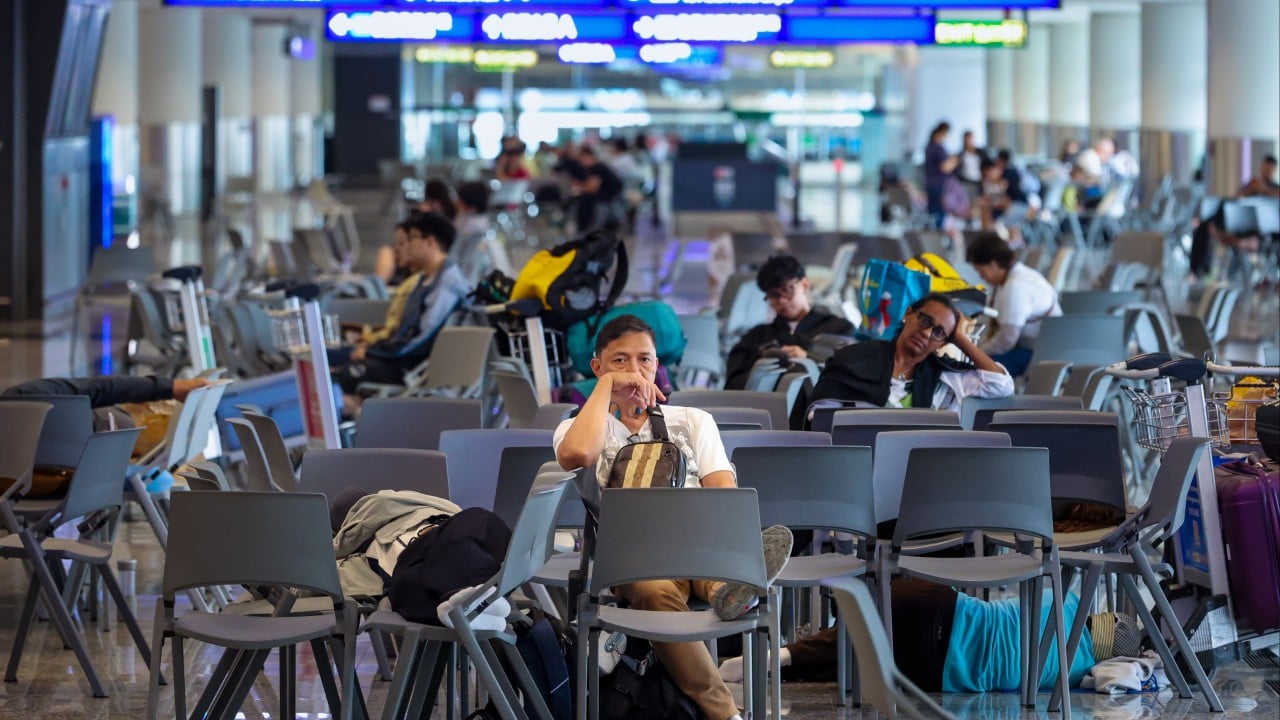
Mass passenger strandings during severe weather events are widely mischaracterized as logistical anomalies. When a meteorological shock forces the suspension of flight operations at a major transit hub like Hong Kong International Airport, the resulting immobilization of thousands of travelers is not a random failure of service. It is the predictable output of a tightly coupled sociotechnical system exceeding its operational capacity.
This analysis deconstructs the mechanics of severe weather disruptions, isolating the structural bottlenecks that transform a temporary airspace closure into a cascading terminal saturation event. Understanding this failure mode requires examining airport resilience through three operational lenses: infrastructure throughput constraints, passenger processing velocity, and carrier asset recovery models.
The Throughput Capacity Equation and the Meteorological Shock
An international aviation hub functions as a high-frequency queueing network. Under standard operating conditions, arrival and departure rates maintain a delicate equilibrium with airspace capacity, gate availability, and ground handling throughput. When a severe typhoon forces a sudden cessation of flights, this queueing system experiences an instantaneous supply shock.
The primary constraint is not merely airspace availability post-storm, but the downstream compounding of terminal and gate geometry. Hong Kong International Airport operates under tight spatial limits relative to its passenger volume. When inbound flights are halted, aircraft cannot vacate arrival gates. Consequently, subsequent arriving aircraft must hold on remote stands or divert to alternative airports.
Once the typhoon passes, the system does not resume at maximum capacity. Safety margins require extended separation intervals for departing and arriving traffic. Furthermore, wind shear verification protocols and ground crew safety thresholds dictate a gradual ramp-up phase. The mismatch between the rapid accumulation of stranded passengers and the linear restoration of throughput velocity creates the terminal saturation bottleneck.
Passenger Processing Velocity and the Terminal Queueing Limit
During an extended disruption, terminal infrastructure shifts from a transient processing facility to a static holding environment. The human element introduces distinct kinetic constraints that automated systems cannot accelerate.
[Meteorological Shock]
       │
       ▼
[Airspace Closure] ──> [Gate Lockout] ──> [Remote Stand Saturation]
       │
       ▼
[Terminal Accumulation] ──> [Processing Bottleneck] ──> [Systemic Gridlock]
Passenger density increases exponentially as check-in counters, transfer desks, and baggage reclaim halls become saturated. The velocity of passenger processing is bound by three strict variables:
- Information Asymmetry: The rate at which displaced travelers receive verified updates regarding rebooking. When communication channels are overwhelmed, passengers resort to physical queueing at service desks, effectively halting queue movement for all other functions.
- Landside Boundary Limits: Security perimeters and immigration checkpoints restrict the free circulation of people. Once airside areas reach maximum occupancy, airport authorities must restrict access, stranding arriving passengers on aircraft parked at remote aprons or trapping departing passengers in landside concourses.
- Resource Elasticity: Ground handling staff, catering logistics, and security personnel operate under fixed labor agreements and fatigue regulations. Unlike digital networks that can scale computing threads dynamically, human resource pools cannot be instantly multiplied during an emergency surge.
The Economic Cost Function of Carrier Recovery Models
Airlines approach disruption management through the lens of asset recovery economics. When Typhoon Noul grounds a fleet, carriers face a severe optimization problem: minimizing the cost of cancelled rotations while maximizing crew legality and aircraft positioning for future schedules.
From a microeconomic perspective, the cost function incorporates passenger duty of care obligations, hotel accommodation expenditures, rebooking penalties, and the opportunity cost of idle aircraft. Network carriers prioritize hub restoration over point-to-point recovery. Consequently, passengers traveling on non-hub itineraries or low-cost carriers frequently experience secondary delays because their routing lacks network redundancy.
When two thousand passengers are stranded overnight, the failure is distributed unevenly across stakeholder balance sheets. Airlines absorb immediate cash outflows for vouchers and lodging, while airport operators suffer reputational damage and potential aeronautical revenue loss. The passengers, however, bear the primary non-financial cost through time depreciation and physical exhaustion in unprovisioned terminal spaces.
Structural Interventions for Resilient Hub Operations
Mitigating catastrophic terminal gridlock requires shifting from reactive passenger management to proactive surge architecture. Traditional approaches rely on expanding physical terminal footprints—an economically unviable strategy given the rarity of peak typhoon events. Instead, resilience must be engineered into operational protocols.
Decentralized digital rebooking engines must replace physical service desks during major disruptions. By shifting rebooking capabilities entirely to mobile applications with automated voucher issuance, airports can eliminate the primary friction point causing indoor crowd accumulation.
Simultaneously, temporary airside-to-landside transit corridors must be standardized. Allowing stranded passengers to exit the security perimeter without sacrificing their ability to re-enter post-clearance prevents concourse blockages.
Deploy decentralized digital rebooking protocols across all operating carriers to eliminate physical queue formation at transfer desks within the first two hours of an airspace closure.