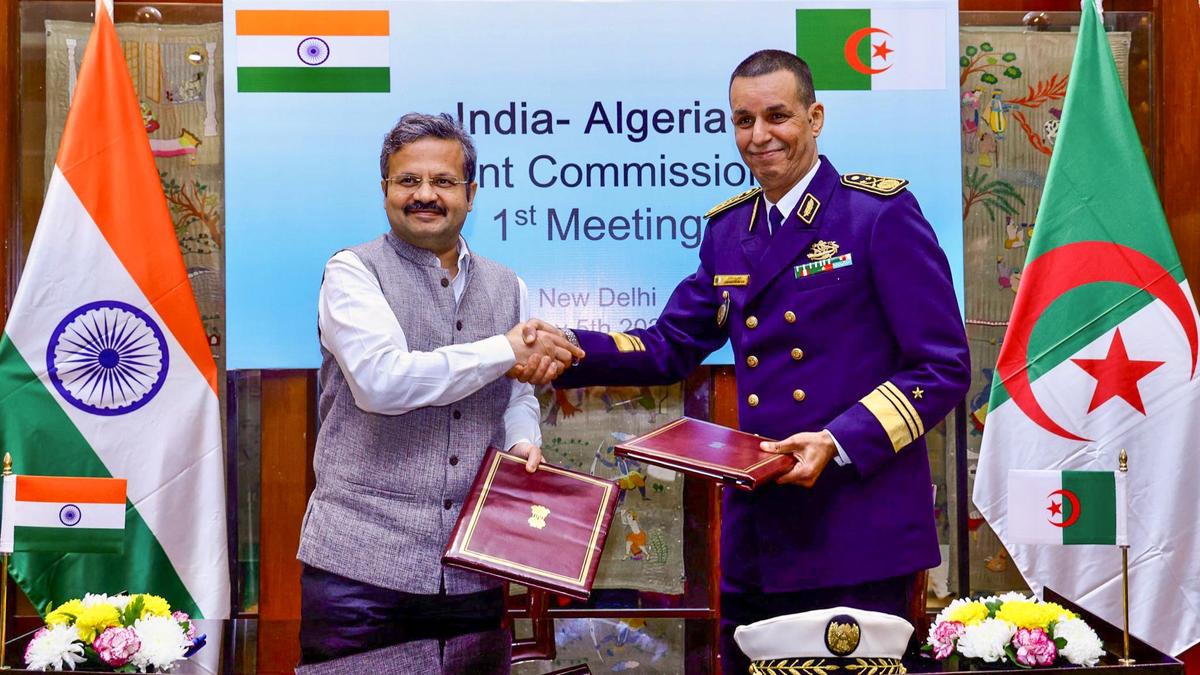
Geopolitics is often just a high-stakes game of keeping appearances. The recent Joint Defence Commission (JDC) meeting between India and Algeria in New Delhi is being hailed by the usual suspects as a "landmark shift" or a "strategic deepening" of ties. It isn't. It is a performative dance between two nations trying to convince themselves they aren't entirely dependent on legacy hardware and outdated Russian supply chains.
If you believe the official communiqués, we are witnessing the birth of a new South-South security axis. If you look at the balance sheets and the actual technical specifications of the hardware involved, you see a desperate attempt to patch a sinking ship with expensive tape.
The Russian Albatross
For decades, Algeria and India have shared a single, suffocating commonality: a pathological reliance on Russian military exports. Algeria is Africa’s largest buyer of Russian arms. India has historically been Russia’s biggest customer globally.
The "consensus" view is that this shared history makes them natural partners for co-development. That logic is flawed. When two entities with the same weakness collaborate, they don't create strength; they compound the vulnerability.
The war in Ukraine has exposed the Russian defense industrial base as a hollowed-out shell. Spare parts for Su-30 fighter jets and T-90 tanks are not just delayed; they are non-existent. Both Algiers and New Delhi are staring at hangars full of "grounded" assets. This JDC meeting wasn't about visionary cooperation. It was a panic-driven support group for nations realizing their primary protector can no longer ship a reliable gearbox.
India is Not a Budget Alternative to the West
The prevailing narrative suggests India can swoop in and replace Russia as Algeria’s primary supplier, offering "affordable" tech without Western political strings. This ignores the brutal reality of Indian defense manufacturing.
India is currently struggling with its own "Indigenization" goals. The Tejas Light Combat Aircraft (LCA) project has been in development for longer than some of its pilots have been alive. While the BrahMos missile—a joint venture with Russia, ironically—is a legitimate piece of kit, most of India's "indigenous" successes are actually integrations of Israeli sensors, French engines, and American avionics.
If Algeria buys from India, they aren't escaping the "Western strings." They are just paying a middleman markup to get diluted versions of the same technology.
I’ve spent years watching procurement cycles in emerging markets. The pattern is always the same. A buyer wants "strategic autonomy," so they avoid the US or France to keep their sovereignty intact. They buy from a secondary power like India. Five years later, they realize the integration costs are 40% higher than expected because the "secondary" platform doesn't talk to their existing radar systems.
The MRO Trap
The most boring acronym in defense is also the most dangerous: MRO (Maintenance, Repair, and Overhaul). The JDC focused heavily on this. The "lazy consensus" says that India setting up MRO hubs in Algeria is a win-win.
In reality, MRO is where defense budgets go to die. Setting up a repair hub for Su-30s in North Africa sounds great until you realize you still need the Russian OEM (Original Equipment Manufacturer) to sign off on the technical blueprints. India cannot legally or technically provide deep-level overhauls for Russian tech without Moscow’s blessing, or they risk their own standing with the Kremlin.
Algeria isn't getting a partner; they are getting a subcontractor who is also struggling to get the same parts from the same shrinking source.
Digital Sovereignty is the Real Battlefield
While the generals in New Delhi and Algiers talk about tanks and artillery, they are missing the digital shift. Modern warfare isn't won by the thickness of the armor; it’s won by the speed of the data link.
India’s strength lies in its software ecosystem. If the JDC were actually revolutionary, they would be talking about cybersecurity, encrypted communication protocols, and AI-driven drone swarms. Instead, they are discussing "joint training" and "cooperation in manufacturing." That is 1970s-era diplomacy.
Algeria sits in a volatile neighborhood. It faces unconventional threats that a T-90 tank is useless against. If India truly wanted to disrupt the market, it would stop trying to sell "hard" iron and start selling "soft" power—proprietary algorithms for border surveillance and signal intelligence. But they won't. Why? Because selling a tank is easier for a bureaucrat to put on a slide deck than explaining a cognitive electronic warfare suite.
The China Factor in the Room
You cannot talk about Algeria and India without acknowledging the dragon in the room. China has been aggressively courting Algiers with infrastructure projects and increasingly sophisticated drones like the CH-4.
The "expert" take is that India is a democratic alternative to Chinese influence in North Africa. This is a feel-good story for Washington, but it doesn't hold up in the Maghreb. Algeria doesn't care about the democratic credentials of its missile providers. It cares about delivery times and price.
China delivers fast. India’s procurement process is a bureaucratic labyrinth where "Requests for Proposals" go to die. By the time India and Algeria move from a Commission meeting to a signed contract, the technology will be a generation behind what Beijing is offering on the open market.
The Costs of "Strategic Autonomy"
There is a high price for not picking a side. India calls it "Multi-alignment." Algeria calls it "Non-alignment." In the defense world, it’s called "Logistical Chaos."
Operating a fleet that includes Russian hulls, French electronics, Indian missiles, and Chinese drones is a nightmare. The training costs alone are astronomical. Every time these two nations meet to discuss "cooperation," they add another layer of complexity to an already fragmented defense posture.
True strategic autonomy doesn't come from buying from five different countries. It comes from having a domestic industrial base that can actually manufacture a semiconductor. Neither country is there yet.
The Real Potential (That They Are Ignoring)
If India and Algeria wanted to actually disrupt the status quo, they would stop looking at each other as buyer and seller. They should look at each other as a testing ground.
Algeria’s terrain is a brutal, high-heat environment that ruins hardware. India’s Himalayan borders are the ultimate test for high-altitude performance. A real "strategic" move would be a joint venture specifically for "extreme environment" electronics—not just more of the same iron and steel.
Instead, we get another meeting, another handshake, and another press release about "potential."
Stop Celebrating the Meeting
Meetings are not achievements. Joint Commissions are not victories. They are the administrative overhead of a relationship that hasn't found its footing.
The defense industry is littered with the corpses of "strategic partnerships" that never produced a single operational unit. Unless India can prove it can export high-end tech without relying on Russian or Western IP, and unless Algeria can prove it can integrate that tech into a coherent doctrine, this is just noise.
Stop looking at the photo ops of generals shaking hands. Look at the shipping manifests. Until the ships start moving with more than just basic ammunition and small arms, the India-Algeria defense axis is a ghost.
The world is moving toward integrated, AI-driven, decentralized warfare. Algeria and India are still arguing over who gets to fix the engines on 30-year-old jets. That’s not a strategy. It’s a funeral for a bygone era of military hardware.
Discard the notion that this meeting changed the balance of power in the Mediterranean or South Asia. It merely confirmed that both nations are desperately seeking an exit strategy from a Russian dependency they can no longer afford, using a roadmap that is decades out of date.
The next time you see a headline about "joint defense cooperation," ask one question: Does this involve a new proprietary code, or is it just more steel? If it’s steel, it’s a distraction.