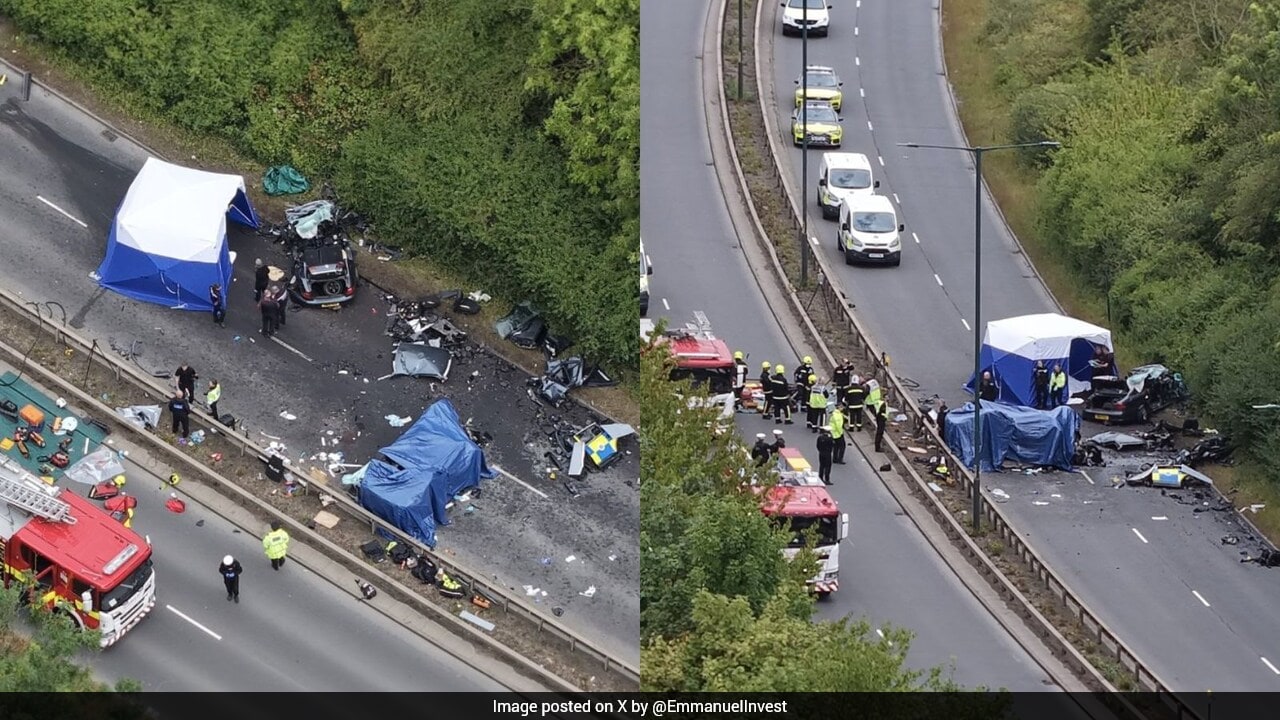
Seven people, including two police officers, died instantly on the A66 near Middlesbrough when a Volkswagen Passat traveling the wrong way at high speed collided head-on with a marked armed response vehicle. The catastrophe, which occurred at 3:39 in the morning, wiped out every occupant across both vehicles. Constables Matthew Blades and Tom Clough did not return from their shift. Five civilian passengers in the oncoming vehicle also perished at the scene.
This devastating collision is not an isolated anomaly on modern roadways. It exposes a terrifying vector in vehicular crime and digital pathology. Law enforcement agencies across the British Isles and Europe are confronting an alarming surge in motorists intentionally driving against traffic. The underlying motivation points toward an unthinkable source: the pursuit of viral validation on social media platforms.
Anatomy of a Catastrophic Pursuit
The sequence on the A66 began with a routine patrol observation. Cleveland Police officers flagged a suspicious vehicle, triggering a tactical pursuit in the pre-dawn hours. High-speed pursuits under optimal conditions test human reaction limits. When a pursued driver enters a dual carriageway heading directly into oncoming traffic, physics dictates an inescapable outcome.
At highway velocities, closing speeds multiply exponentially. A vehicle traveling at seventy miles per hour meeting another at seventy miles per hour creates an impact energy profile that modern safety cages and airbags cannot mitigate. The wreckage on the A66 required a mandatory independent referral to the Independent Office for Police Conduct. Investigators must parse the milliseconds between the initial spot, the tactical decisions made by the officers, and the terminal impact.
Yet focusing solely on the mechanics of the chase misses the broader pathology. Why would multiple individuals remain inside a car driving headlong into oncoming traffic?
The Digital Contagion of Road Stunts
Safety authorities are tracing a direct line between online clout economics and reckless driving behavior. Recent weeks have forced transport ministries and policing chiefs to confront a grim trend. Young drivers are deliberately entering motorways and major dual carriageways against the flow of traffic to capture footage for short-form video algorithms.
The mechanics are straightforward and lethal. Platforms reward high-arousal content. Fear, shock, and perceived rebellion generate algorithmic velocity. A video capturing the white lines rushing past on the wrong side of a central reservation yields immediate metric spikes. Regulators in Ireland recently issued urgent public warnings after similar head-on incidents, explicitly calling out platforms like TikTok for hosting content that glorifies vehicular defiance.
When algorithms optimize for engagement without friction, real-world asphalt becomes a casualty. The five individuals in the Volkswagen Passat became part of a grim demographic experiment run by algorithms that monetize adrenaline.
Institutional Blind Spots and the Policing Crisis
For frontline officers, routine patrol work carries an escalating matrix of unpredictability. Police drivers undergo rigorous training in advanced pursuit tactics, Smith System spatial awareness, and dynamic risk assessment. They calculate weather conditions, pedestrian density, and vehicle performance capabilities.
They cannot easily factor in a counterparty whose primary objective is self-destruction for digital entertainment. When a suspect decides that escaping a standard stop involves turning into a suicidal missile, standard protocols fracture.
Chief Constable Victoria Fuller addressed a grieving force and community, noting the immense toll exacted on the policing family. Prime Minister Andy Burnham and Home Secretary Shabana Mahmood issued statements acknowledging the profound grief gripping the region. Condolences offer little structural comfort to stations facing depleted rosters and heightened threats.
The Accountability Vacuum
As the Independent Office for Police Conduct reviews the telemetry and radio transmissions from that morning, the broader policy debate turns toward platform liability. Law enforcement agencies find themselves outgunned by digital infrastructure that permits the broadcast of dangerous driving challenges with minimal pre-moderation.
European regulators are demanding algorithmic transparency reports from social media companies, questioning how content encouraging wrong-way driving bypasses safety filters. Tech firms point to automated moderation tools, yet human behavior continually outpaces static keyword blocks.
The A66 remains scarred by the temporary road closures, drone exclusion zones, and the physical markers of an investigation that will take months to untangle. Families are left burying relatives who went to work or went out into the night, caught in the intersection of high-speed transit and malignant digital subcultures.
The investigation will produce transcripts, timing sheets, and expert reconstructions. It will not alter the fundamental reality that modern roads now carry a hidden class of hazard born in the illuminated glow of a smartphone screen.