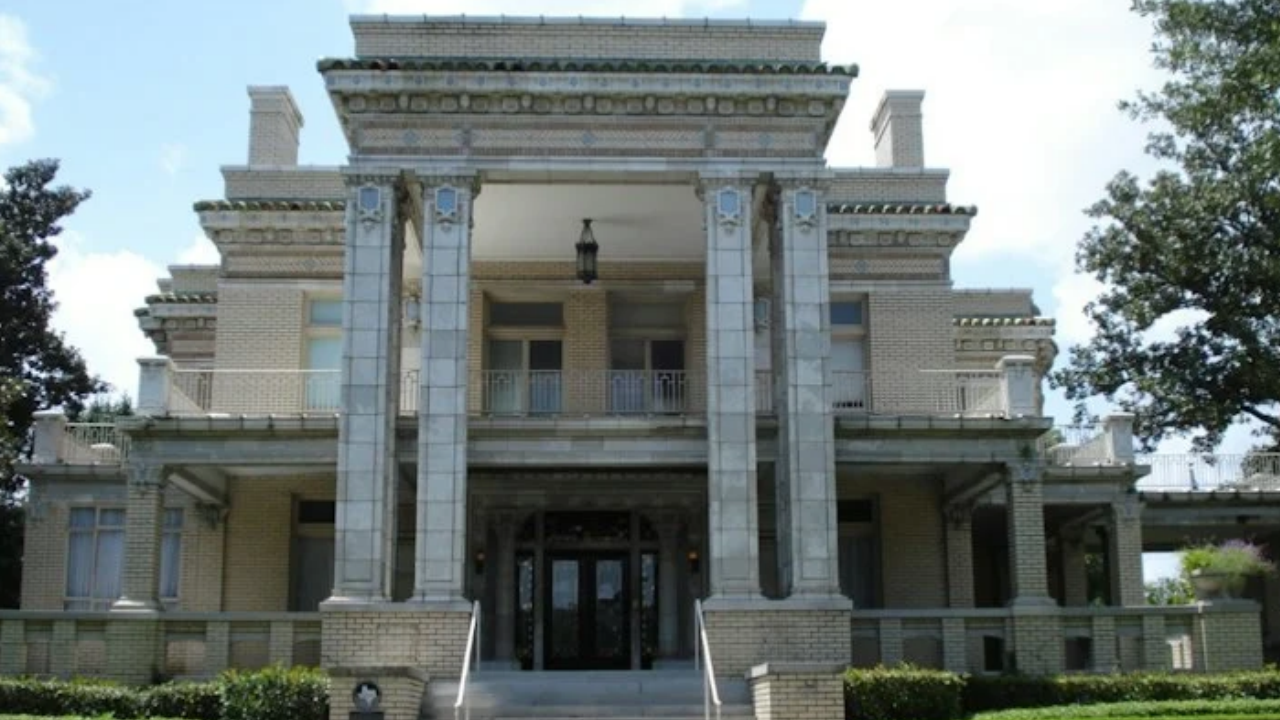
Standing on the curb at 1911 Cleveland Street in Houston, you can almost hear the iron-rimmed wheels clattering over dirt before the pavement ever arrived.
Wait. Look closer at the brick.
It isn't the uniform, machine-extruded clay you see on modern suburban McMansions out in Katy or The Woodlands, where every facade looks like a printed sticker applied to drywall; this is heavy, hand-laid masonry from 1911, baked in kilns that smelled of pine wood and river mud when William Howard Taft was in the White House and Houston was still a scrappy, mosquito-bitten bayou town trying to convince the world it had a future. Today, that brick is asking for $3,995,000. Back in 2015, the exact same structure traded hands for roughly seventy percent less, a jump that looks like pure, unadulterated madness on a spreadsheet until you actually step across the threshold and feel the floor joists hold your weight without a single whisper of a groan.
I have walked through dozens of historic restorations over the past twenty years, and I will tell you a secret that real estate brokers rarely print on glossy brochures: buying a century-old house is terrifying. Honestly, it is a mild form of financial masochism. You lie awake at three in the morning listening to the wind rattle the original wavy-glass panes, wondering if that faint damp spot near the crown molding is a harmless condensation ring or a forty-thousand-dollar cast-iron plumbing stack quietly rotting behind horsehair plaster. Yet people keep lining up with millions of dollars to take the gamble. Why? Because in a city famous for tearing down its own memory every thirty years to build glass towers and strip malls, survival itself has become the ultimate luxury asset.
The Anatomy of a Seventy Percent Leap
To understand how a house in Houston’s Fourth Ward—or sitting right on the razor’s edge of the historic Freedmen’s Town and downtown corridor—climbs roughly seventy percent in value over a single decade, you have to stop looking at square footage and start looking at scarcity.
Consider a hypothetical buyer. Let us call her Elena. Elena is forty-six, a neurosurgeon at the Texas Medical Center ten minutes south, and she spends twelve hours a day staring at high-resolution digital scans inside windowless, climate-controlled rooms where everything is sterile, modular, and replaceable. When Elena goes house hunting on a Sunday afternoon, she does not want quartz countertops that look like plastic, nor does she want twenty-foot drywall ceilings that echo like an airport terminal. She wants weight. She wants rooms that have already survived two world wars, the Great Depression, the 1980s oil bust, and Hurricane Harvey without flinching.
When 1911 Cleveland last sold in 2015, Houston was staring down the barrel of a brutal crude oil slump. Oil had crashed from over a hundred dollars a barrel to under forty, layoffs were rippling through the Energy Corridor, and historic urban pockets near downtown were still treated by cautious buyers as speculative frontiers rather than blue-chip sanctuaries. Back then, paying around $2.35 million for a sprawling 1911 mansion felt like an eccentric passion project.
Ten years later, the math of the city has inverted completely.
Downtown Houston and the surrounding inner-loop neighborhoods have undergone a massive demographic shift, pulling affluent professionals away from ninety-minute commutes and back toward the urban core. At the same time, construction costs for custom luxury builds have skyrocketed—lumber, skilled millwork, copper flashing, and insurance premiums have pushed the cost of building a new mansion from scratch well past six or seven hundred dollars a square foot before you even buy the dirt. Suddenly, $3.995 million for an irreplaceable 1911 architectural landmark does not look like an inflation bubble. It looks like buying a signed, original oil painting for the price of a high-end digital print.
What Time Actually Buys You
Walk inside a house built in 1911, and your nervous system immediately registers something your conscious brain might miss: the smell and the silence.
Modern homes are built out of fast-growth pine harvested from tree farms when the trunks are barely fifteen years old. The grain is wide, soft, and spongy; it warps when the Gulf Coast humidity hits ninety percent in August, and it carries sound like a drumhead. In 1911, carpenters in Southeast Texas were framing walls and milling floorboards out of virgin longleaf yellow pine—trees that had stood in dense forests for three hundred years before a saw ever touched them. The growth rings in that wood are packed as tight as pages in a closed dictionary. Termites break their jaws on it. Nails bend trying to penetrate it. And when you walk across those floorboards in leather-soled shoes, they do not bounce or squeak; they absorb your footsteps like stone.
Think of a historic mansion like a vintage mechanical watch compared to a brand-new smartwatch.
The smartwatch does ten thousand things, connects to satellites, and looks sleek for about thirty-six months until its battery degrades and its operating system becomes obsolete, turning it into an expensive paperweight. The mechanical watch—say, a Patek Philippe assembled by hand in 1911—only tells the time. It requires periodic servicing, you cannot drop it in a swimming pool, and you have to wind it with your own fingers. Yet a century later, the mechanical watch is worth ten times its original price because nobody possesses the time, patience, or cheap labor required to build one like it anymore.
That is the invisible engine driving the $3.995 million price tag at 1911 Cleveland. You are not paying nearly four million dollars for four walls and a roof. You are paying for:
- Old-growth timber and hand-troweled plaster that naturally regulate indoor humidity and dampen street noise far better than synthetic insulation and half-inch gypsum board.
- Architectural proportions designed before air conditioning existed, featuring soaring twelve-foot ceilings, deep wrap-around porches, and transoms positioned specifically to pull prevailing Gulf breezes through the central hallways.
- Irreplaceable urban geography, sitting minutes from Houston’s theater district, Buffalo Bayou Park, and the medical center on a lot size that developers today would have chopped into six three-story townhomes.
The Ghost in the Ledger
Of course, romance does not pay property taxes, and Harris County tax assessors are famously unsentimental about architectural poetry.
If you are considering stepping into the ring for a property at this tier, you have to confront the unglamorous reality hiding behind the manicured hedges. Owning a 1911 estate in Texas means entering into a permanent, expensive truce with climate and entropy. Even when a historic mansion has been meticulously updated with modern zoned HVAC systems, commercial-grade electrical panels, and reinforced foundations, the ongoing carrying costs operate in a completely different universe from standard residential real estate.
Property taxes in Texas hover around two percent of assessed value—meaning a $3.995 million valuation translates to roughly $80,000 a year just for the privilege of holding the deed, before you pay a single dollar toward homeowner’s insurance, yard maintenance, or utility bills. And insurance along the upper Texas coast has become a high-stakes poker game of its own. Insurers scrutinize the age of the roof, the type of wiring, the proximity to bayou floodplains, and the replacement cost of custom millwork that cannot be sourced at a big-box hardware store.
I remember talking to a couple in Houston’s Heights neighborhood a few years back who had poured their life savings into restoring a 1914 Queen Anne. On the day they finally finished stripping six layers of lead paint off the parlor pocket doors, a main water line ruptured beneath the pier-and-beam foundation. They stood in their kitchen at midnight with water pooling around their ankles, laughing hysterically because crying would have required too much energy. They loved that house with a fierceness that bordered on irrational, and the house demanded every ounce of their patience in return.
That is the unspoken contract of 1911 Cleveland. Anyone who buys it purely as a spreadsheet investment—hoping to flip it in twenty-four months for another seventy percent gain—will likely be miserable. Historic estates punish mercenaries and reward stewards.
Why Houston Keeps Trying to Erase Itself—And Why That Makes This Priceless
To truly grasp the emotional weight of a 1911 mansion still standing near downtown Houston, you have to understand the city’s restless, almost violent relationship with its own past.
Unlike Boston, Savannah, or New Orleans, Houston has never been a museum city. Zoning laws famously do not exist here in the traditional sense; deed restrictions and market appetite dictate what survives and what gets flattened. Over the last century, countless Gilded Age mansions along Main Street and San Jacinto were bulldozed to make way for surface parking lots, medical plazas, and mid-rise apartments. Every time a wrecking ball swung into a 1910 brick facade, the remaining survivors grew exponentially rarer.
Let us return to Elena, our hypothetical neurosurgeon, standing in the foyer of 1911 Cleveland during a private twilight showing.
Outside, the amber glow of downtown skyscrapers reflects off the low clouds, and the distant hum of Interstate 45 sounds like surf breaking on a faraway beach. Inside, the late-afternoon sun cuts through leaded-glass sidelights, throwing prism rainbows across a staircase banister worn smooth by thousands of hands over one hundred and fifteen years. Some of those hands belonged to early twentieth-century oilmen and cotton merchants; others belonged to domestic workers, children sliding down the rail in wool socks, and families celebrating weddings and mourning losses through a century of American history.
In a world where everything we touch is increasingly ephemeral—digital photographs stored in clouds we do not own, music we rent by the month, cars controlled by software updates, and houses slapped together in ninety days out of engineered composite—standing inside something permanent produces a physical ache. You realize that you do not actually own a house like 1911 Cleveland. You are simply renting a chapter in its biography, holding the keys for ten or twenty years before passing them to the next person brave enough to care for it.
The listing price says $3,995,000, and the market analysts will spend weeks dissecting that seventy percent climb since 2015, comparing price-per-square-foot metrics across Montrose, River Oaks, and Boulevard Oaks. They will talk about interest rates, inventory shortages, and inner-loop appreciation curves.
They will miss the point entirely.
You cannot manufacture 1911, and when the last brass key turns in that heavy oak front door at dusk, shutting out the noise of a city in a hurry, the silence inside is worth every penny.