The courtroom in Porto Alegre does not look like the epicenter of a global industrial revolution. Yet, inside its concrete walls, a legal mechanism is quietly moving that could permanently rewrite the survival arithmetic for the world's most profitable energy corporations.
Brazil's Federal Public Prosecutor's Office, acting alongside the Preservar Institute, has filed a public civil action demanding that Shell Brasil Petróleo Ltda pay roughly 108 million dollars. The target is not an oil spill on a pristine coastline, nor a localized refinery blowout. The target is the sky itself—or rather, the cumulative atmospheric exhaustion left behind by a century of carbon extraction.
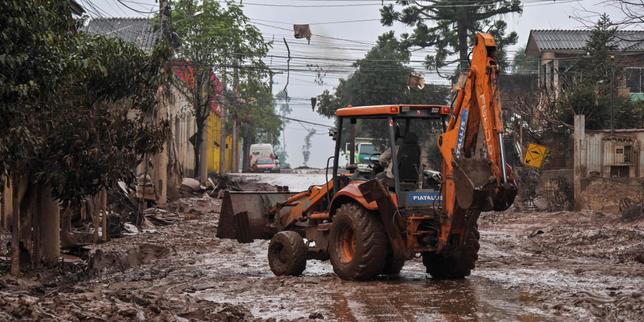
This is the first time a national public prosecution service has dragged an oil major into court to foot the bill for a specific, localized weather disaster. The catastrophic flooding that drowned the state of Rio Grande do Sul in 2024 left towns submerged, economies shattered, and hundreds of thousands displaced. Traditional jurisprudence would point fingers at heavy seasonal rains and saturated ground. The Brazilian state is pointing directly at the corporate balance sheets of the carbon majors.
To understand why this specific lawsuit is rattling boardrooms from London to Houston, one must look past the headline figure. One hundred and eight million dollars is pocket change for a multinational energy titan. What keeps legal strategists awake at night is the mathematical bridge the prosecutors have built between global emissions and localized catastrophe.
For decades, climate litigation faced an insurmountable wall of causation. A farmer in Peru suing a German energy company over glacial melt found himself trapped in an evidentiary labyrinth. Proving that a specific molecule of carbon dioxide emitted by a specific smokestack melted a specific chunk of ice in the Andes was scientifically tricky and legally impossible. Courts repeatedly threw up their hands, declaring the chain of causality too diffuse, too scattered across humanity's collective choices to pin on any single actor.
The Brazilian filing bypasses that traditional gridlock by weaponizing attribution science.
Instead of tracing individual molecules, the prosecutors rely on three hard structural pillars. First, they take the baseline warming figures established by the Intergovernmental Panel on Climate Change. Second, they utilize the Carbon Majors database, which tracks historical industrial emissions. That database pegs Shell as responsible for roughly 2.02 percent of all cumulative global industrial carbon dioxide and methane emissions since 1854. Third, they lean on peer-reviewed meteorological event attribution studies showing that human-driven global warming made the 2024 Rio Grande do Sul deluges approximately twice as likely and significantly more intense.
Multiply the total collective public cost of the disaster by Shell's historical emission footprint, and the math spits out the 108 million dollar demand. It is a proportional liability model. It treats the atmosphere not as an infinite sink, but as a shared asset whose degradation can be quantified, metered, and billed.
This approach avoids the traditional hurdles of individual tort law. The state is not representing a single aggrieved homeowner who might have built too close to a riverbank. The state is suing on behalf of the collective public interest, invoking Brazil’s robust National Environmental Policy Act, which enforces strict liability for environmental degradation. Under this statute, proving corporate negligence or bad faith is entirely unnecessary. If you caused the harm, you pay to mend it.
Shell's official response has been muted, noting that the corporation has not yet been formally notified through official diplomatic channels. Behind closed doors, however, defense counsels are preparing a multi-pronged counter-offensive. They will question whether the global emissions of a multinational parent company can legally be pinned onto a local Brazilian subsidiary. They will challenge whether an intensity proxy is an intellectually honest basis for dividing up the financial responsibility of a chaotic, multi-causal meteorological event.
They are right to point out the gray areas. The law has never been particularly good at handling shared, distributed guilt. If every major oil company, coal conglomerate, and cement manufacturer is sued in proportion to its historical ledger, the global economy enters a permanent state of judicial warfare. Every flood, every wildfire, and every prolonged drought becomes a potential class-action lawsuit waiting for a clever prosecutor with an attribution model.
Yet the energy sector brought this upon itself. For decades, corporate research departments accurately predicted the exact planetary consequences of burning fossil fuels while their public relations departments funded campaigns designed to sow doubt about those very mechanisms. The chickens are simply coming home to roost in developing nations that contributed the least to historical industrialization while bearing the brunt of its atmospheric fallout.
If the federal court in Porto Alegre accepts the logic of the prosecution, the ripple effects will cross oceans instantly. Insurers will reprice risk across entire continents. Fossil fuel extraction projects will need to factor localized climate litigation into their capital expenditure models as a standard line item, right alongside seismic testing and pipeline permits.
The era of treating the sky as a free dumping ground is expiring. When the bill finally arrives, it will not be paid in abstract political promises, but in hard currency extracted from the very entities that fueled the fire.